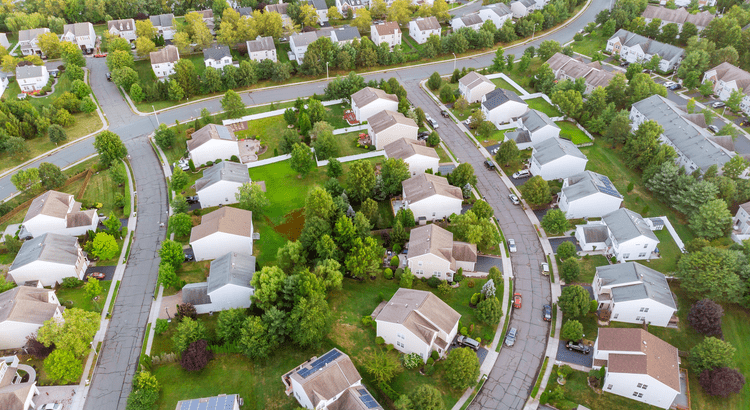
Open up a home search and you'll see them. Listings that have been on the market for two months. Three. Some longer.
Most buyers scroll right past them, assuming something’s wrong with the house. But that instinct could be costing you, since the longer a home sits, the more motivated the seller usually gets.
If affordability has been your #1 hurdle to buying, here’s a surprisingly simple strategy that could help you finally get your foot in the door. Start with the homes that have been sitting the longest. That’s often where the best deals are.
Here’s why. Data from Realtor.com shows there’s a connection between longer time on the market and lower sales prices. Basically, the longer a house sits, the more likely it is that the seller will reduce the price (see graph below):
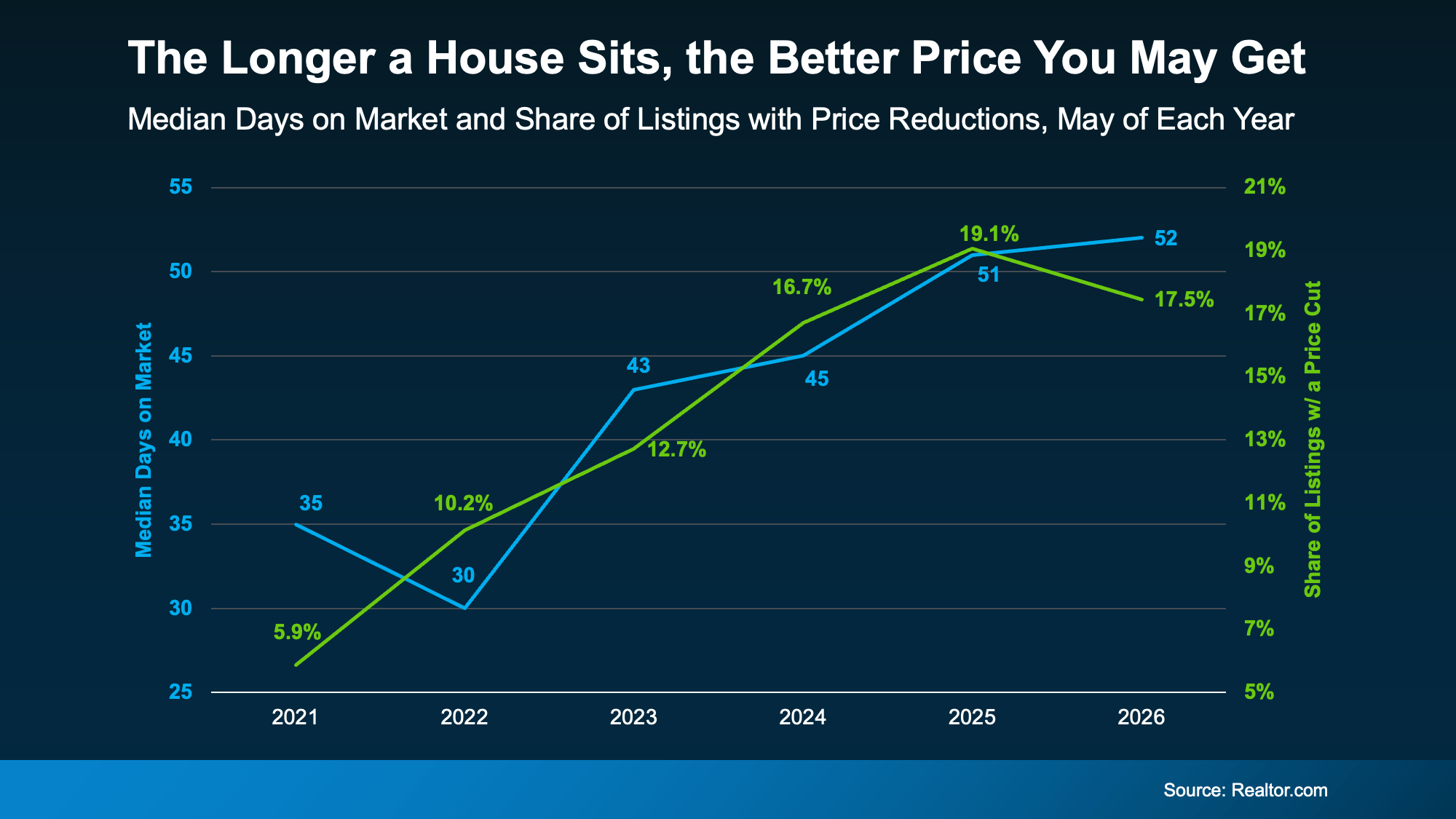
The blue line tracks how long homes stay on the market, while the green line tracks the share of homes getting a price reduction. As one climbs, so does the other.
And if you focus on these homes that are just sitting and waiting, the opportunity for you is bigger than you may think right now.
Redfin data shows there’s $347 billion worth of stale listings on the market right now – more than ever before for this time of year. So, ask your agent to filter listings for you from oldest to newest. The home that fits your budget might already be there. Just further down the list than you thought.
Let’s say you do that and something catches your eye. Still, you might be questioning why the home has been sitting in the first place. Just remember, sometimes it has nothing to do with the home itself.
According to Redfin, common causes are:
The asking price was set too high to start
The home didn’t show well online
There are a lot of homes for sale in the area, so it just got buried
So, nothing that’s necessarily a dealbreaker, or even anything that’s wrong with the home itself. If there’s a real issue, a thorough inspection will surface it. And that’s information you can use to negotiate. Not a reason to assume it’s a house worth skipping over.
So how do you capitalize on a lingering listing? According to USA Today, you have two main levers to pull.
The first is price. Work with your agent to study what comparable homes recently sold for, then build an offer around that. Coming in below asking price is fair game when a home has been sitting.
The second is concessions. If a seller won’t budge much on price, they may still help in other ways, like covering some closing costs, repair credits, or even a mortgage rate buydown that lowers your monthly payment.
A local agent has the context to tell which homes are the real opportunities and which are skippable.
A house sitting on the market isn’t always a glaring red flag. In today’s market, it may be your best opportunity yet.
For help deciding which lingering listings are actually worth a second look, let’s connect.
The information contained, and the opinions expressed, in this article are not intended to be construed as investment advice. Keeping Current Matters, Inc. does not guarantee or warrant the accuracy or completeness of the information or opinions contained herein. Nothing herein should be construed as investment advice. You should always conduct your own research and due diligence and obtain professional advice before making any investment decision. Keeping Current Matters, Inc. will not be liable for any loss or damage caused by your reliance on the information or opinions contained herein.
What Makes a House a Home?

There's no denying the long-term financial benefits of owning a home, but today's housing market may have you wondering if now's still the time to buy. While the financial aspects of buying a home are important, the non-financial and emotional reasons are too.
Home means something different to all of us. Whether it's sharing memories with loved ones at the kitchen table or settling in to read a book in a favorite chair, the emotional connections to our homes can be just as important as the financial ones. Here are some of the things that make a house a home.
1. You Can Be Proud of Your Accomplishment
Buying a home is a major life milestone. Whether you're setting out to buy your first home or your fifth, congratulations will be in order when you've achieved your goal. The sense of accomplishment you'll feel at the end of your journey will truly make your home feel like a special place.
2. You Have Your Own Designated Happy Place
Owning your own home offers not only safety and security, but also a comfortable place where you can relax and unwind after a long day. Sometimes that's just what you need to feel recharged and content.
3. You Can Find the Space To Meet Your Needs
Whether you want more room for your changing lifestyle (like retirement, dedicated space for a hobby, or a personal gym) or you simply prefer to have a large backyard for entertaining, you can invest in a home that truly works for your evolving needs.
4. You Can Customize Your Surroundings
Looking to try one of those decorative wall treatments you saw online? Tired of paying an additional pet deposit for your apartment building? Or maybe you want to create an in-home yoga studio. You can do all these things in your own home.
Bottom Line
Whether you're planning to purchase your first home or you're ready to buy a different home to meet your needs, consider the emotional benefits that can turn a house into a happy home. When you're ready to make a move, let's connect.
|
|
What To Expect From the Housing Market in 2023

The 2022 housing market has been defined by two key things: inflation and rapidly rising mortgage rates. And in many ways, it’s put the market into a reset position.
As the Federal Reserve (the Fed) made moves this year to try to lower inflation, mortgage rates more than doubled – something that's never happened before in a calendar year. This had a cascading impact on buyer activity, the balance between supply and demand, and ultimately home prices. And as all those things changed, some buyers and sellers put their plans on hold and decided to wait until the market felt a bit more predictable.
But what does that mean for next year? What everyone really wants is more stability in the market in 2023. For that to happen we'll need to see the Fed bring inflation down even more and keep it there. Here's what housing market experts say we can expect next year.
What's Ahead for Mortgage Rates in 2023?
Moving forward, experts agree it's still going to be all about inflation. If inflation is high, mortgage rates will be as well. But if inflation continues to fall, mortgage rates will likely respond. While there may be early signs inflation is easing as we round out this year, we're not out of the woods just yet. Inflation is still something to watch in 2023.
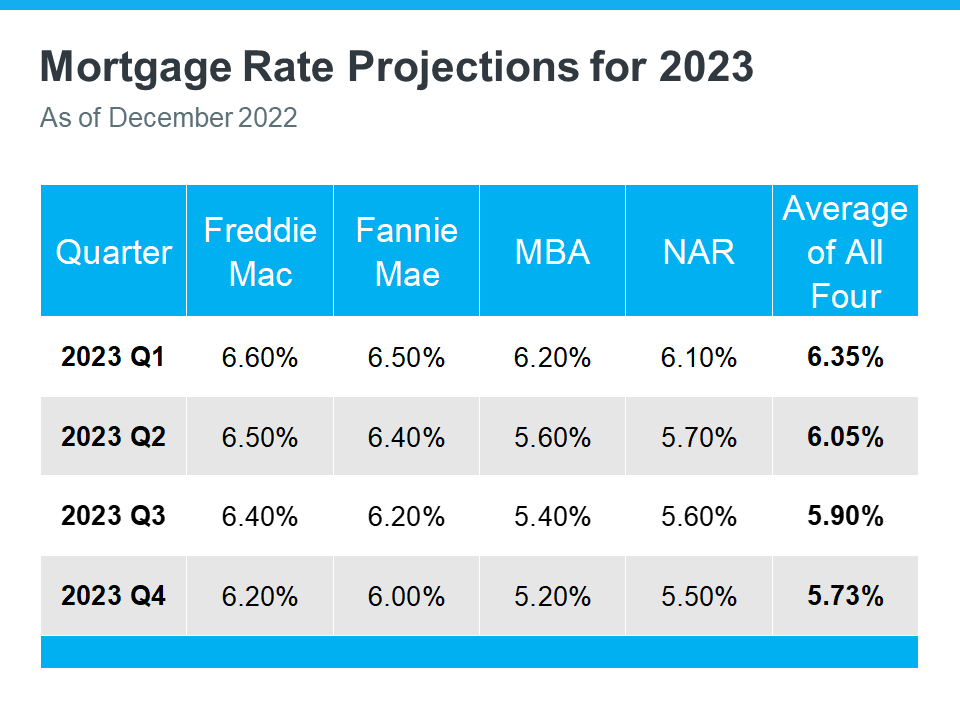
Right now, experts are factoring all of this into their mortgage rate forecasts for next year. And if we average those forecasts together, experts say we can expect rates to stabilize a bit more in 2023. Whether that's between 5.5% and 6.5%, it's hard for experts to say exactly where they'll land. But based on the average of their projections, a more predictable rate is likely ahead (see chart below):
That means, we'll start the year out about where we are right now. But we could see rates tick down if inflation continues to drop. As Greg McBride, Chief Financial Analyst at Bankrate, explains:
. . . mortgage rates could pull back meaningfully next year if inflation pressures ease.
In the meantime, expect some volatility as rates will likely fluctuate in the weeks ahead. If we see inflation come back under control, that would be good news for the housing market.
What Will Happen to Home Prices Next Year?
Homes prices will always be defined by supply and demand. The more buyers and fewer homes there are on the market, the more home prices will rise. And that's exactly what we saw during the pandemic.
But this year, things changed. We've seen home prices moderate and housing supply grow as buyer demand pulled back due to higher mortgage rates. The level of moderation has varied by local area – with the biggest changes happening in overheated markets. But do experts think that will continue?
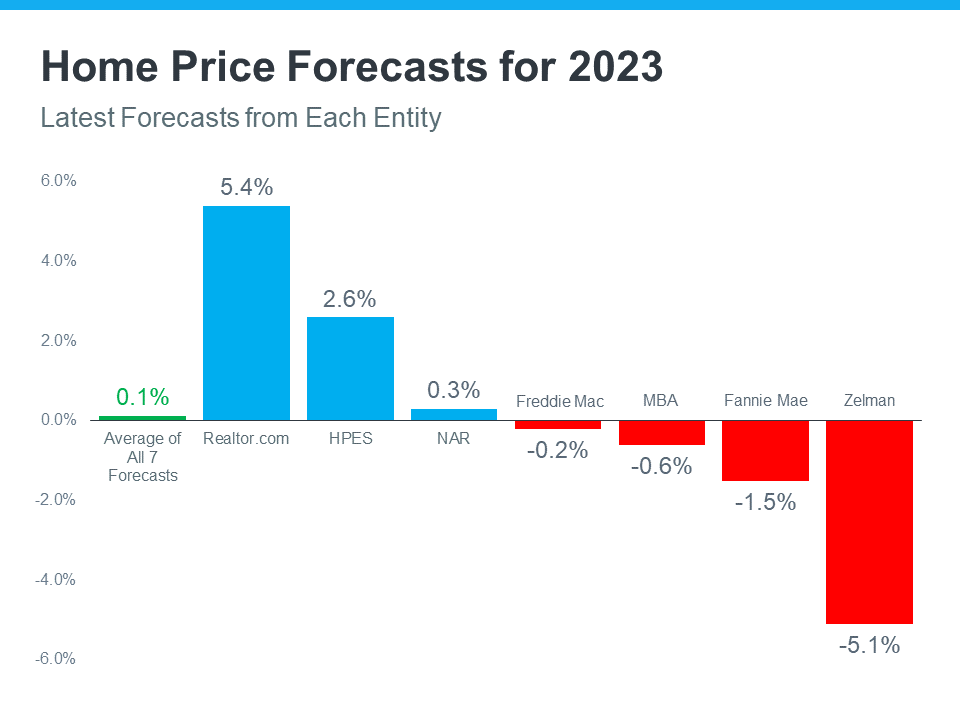
The graph below shows the latest home price forecasts for 2023. As the different colored bars indicate, some experts are saying home prices will appreciate next year, and others are saying home prices will come down. But again, if we take the average of all the forecasts (shown in green), we can get a feel for what 2023 may hold.
The truth is probably somewhere in the middle. That means nationally, we'll likely see relatively flat or neutral appreciation in 2023. As Lawrence Yun, Chief Economist at the National Association of Realtors (NAR), says:
After a big boom over the past two years, there will essentially be no change nationally . . . Half of the country may experience small price gains, while the other half may see slight price declines.
Bottom Line
The 2023 housing market is going to be defined by mortgage rates, and rates will be determined by what happens with inflation. The best way to keep a pulse on what experts are projecting for next year is to lean on a trusted real estate advisor. Let's connect.
|
|
Mortgage Rates Are Dropping. What Does That Mean for You?

Mortgage rates have been a hot topic in the housing market over the past 12 months. Compared to the beginning of 2022, rates have risen dramatically. Now they're dropping, and that has to do with everything happening in the economy.
Nadia Evangelou, Senior Economist and Director of Forecasting at the National Association of Realtors (NAR), explains it well by saying:
Mortgage rates dropped even further this week as two main factors affecting today’s mortgage market became more favorable. Inflation continued to ease while the Federal Reserve switched to a smaller interest rate hike. As a result, according to Freddie Mac, the 30-year fixed mortgage rate fell to 6.31% from 6.33% the previous week.
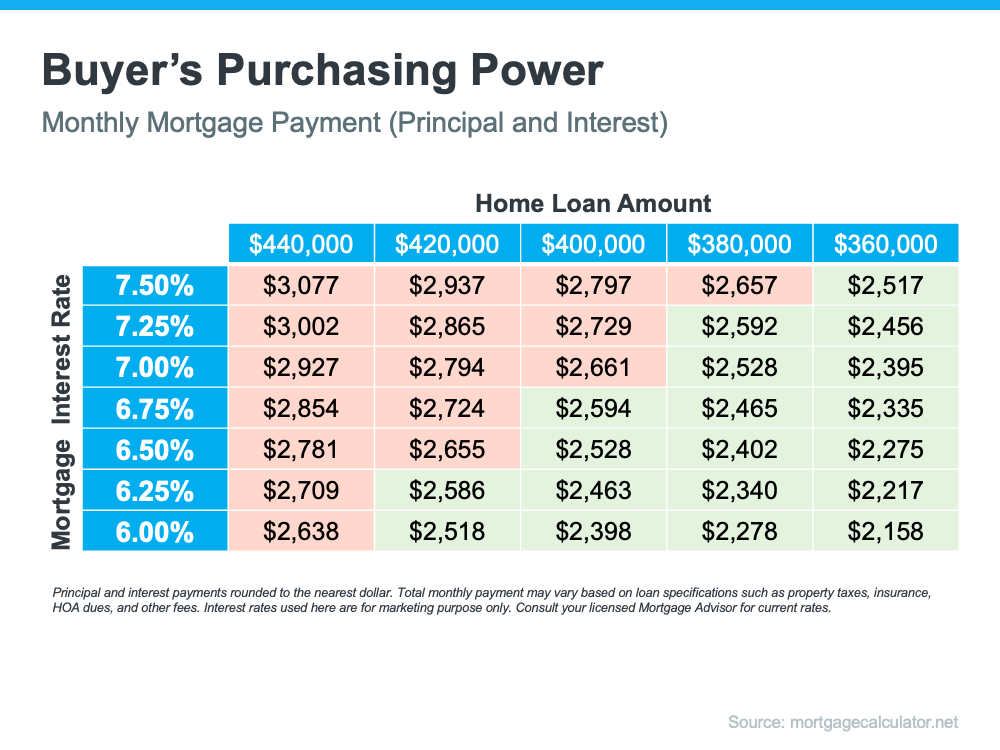
So, what does that mean for your homeownership plans? As mortgage rates fluctuate, they impact your purchasing power by influencing the cost of buying a home. Even a small dip can help boost your purchasing power. Here's how it works.
The median-priced home according to the National Association of Realtors (NAR) is $379,100. So, let's assume you want to buy a $400,000 home. If you're trying to shop at that price point and keep your monthly payment about $2,500-2,600 or below, here's how your purchasing power can change as mortgage rates move up or down (see chart below). The red shows payments above that threshold and the green indicates a payment within your target range.
This goes to show, even a small quarter-point change in mortgage rates can impact your monthly mortgage payment. That's why it's important to work with a trusted real estate professional who follows what the experts are projecting for mortgage rates for the days, months, and year ahead.
Bottom Line
Mortgage rates are likely to fluctuate depending on what happens with inflation moving forward, but they have dropped slightly in recent weeks. If a 7% rate was too high for you, it may be time to contact a lender to see if the current rate is more in line with your goal for a monthly housing expense.
|
|
2023 Housing Market Forecast [INFOGRAPHIC]
![2023 Housing Market
Forecast [INFOGRAPHIC] | MyKCM](https://ecp.yusercontent.com/mail?url=https%3A%2F%2Ffiles.mykcm.com%2F2022%2F12%2F15125347%2F2023-Housing-Market-Forecast-MEM-236x600.png&t=1671203866&ymreqid=fa91d6a0-6d01-c85b-1c4d-f90001012c00&sig=HYonZJ7qRbP7V.Bg544Zrw--~D)
Some Highlights
- From home sales to prices, the 2023 housing market will be defined by mortgage rates. And where rates go depends on what happens with inflation.
- If you're thinking of buying or selling a home this year, let's connect so you understand where the housing market is headed in 2023.
Sources:
Homeownership Is an Investment in Your Future

There are many people thinking about buying a home, but with everything affecting the economy, some are wondering if it's a smart decision to buy now or if it makes more sense to wait it out. As Bob Broeksmit, President and CEO of the Mortgage Bankers Association (MBA), explains:
The desire for homeownership is strong. Many prospective buyers are waiting for the volatility in mortgage rates to subside, as well as for a clearer picture of the economic outlook.
If you're in that position, remember that it's important to consider not just what's happening today but also what benefits you may gain in the long run.
There's a lot of information out there about how homeownership helps build a homeowner's net worth over time. But even today, many people think first about things like 401(k)s before they think of owning a home as a wealth-building tool. It's especially important if you're a young prospective homebuyer to understand how homeownership is another key way to invest in your future. An article from Bloomberg notes:
Millennials have higher average 401(k) balances than Generation X did when they were the same age, but they’re not any better off financially. . . . A lot of that has to do with being less likely to own a home.
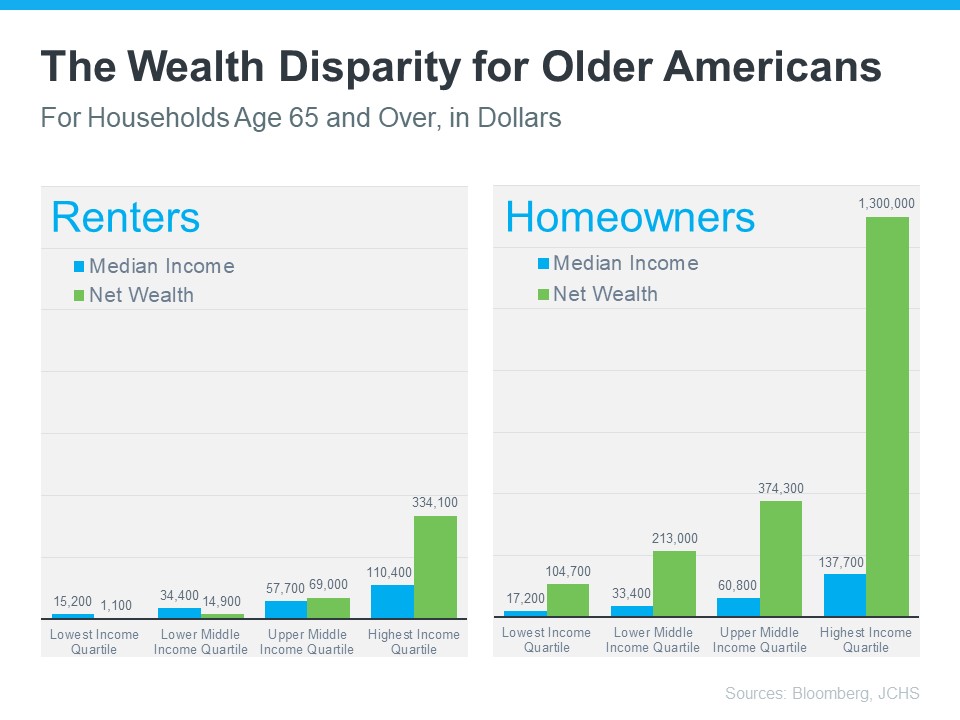
To help you understand just how much owning a home can have a positive impact on your life over the years, take a look at what the data shows. The same Bloomberg article helps show the gap in wealth between renters and homeowners who are 65 years and older (see graph below). The difference is substantial, even when incomes are similar.
So, if you want to create wealth to help set you up for success later on, it may be time to prioritize homeownership. That's because, whether you decide to rent or buy a home, you'll have a monthly housing expense either way. The question is: are you going to invest in yourself and your future, or will you help someone else (your landlord) increase their wealth?
Bottom Line
Before putting your homeownership plans on hold, let's connect to go over your options. That way, you'll have expert advice on how to make the best decision right now and the best investment in your future.
|
|
|
If you're thinking about buying or selling a home this year, you may have questions about what's happening with home prices today as the market cools. In the simplest sense, nationally, experts don't expect prices to come crashing down, but the level of home price moderation will depend on factors like supply and demand in each local market. That means, moving forward, home price appreciation will continue to vary by location, with more significant changes happening in overheated areas. Here's a quick snapshot of what the experts are saying: Danielle Hale, Chief Economist at realtor.com, says:
Mark Fleming, Chief Economist at First American, says:
Taylor Marr, Deputy Chief Economist at Redfin, says:
John Paulson, Founder of Paulson & Co., says:
What Does This Mean for You?The best way to get the answers you need is to lean on a local real estate advisor. They'll be able to explain the latest trends in your specific market so you can make a confident and informed decision on your next step toward buying or selling a home. Bottom LineIf you have questions about what's happening with home prices today, let's connect so you have the latest on our local market.
|
Winter Home Selling Checklist [INFOGRAPHIC]
![Winter Home Selling Checklist
[INFOGRAPHIC] | MyKCM](https://ecp.yusercontent.com/mail?url=https%3A%2F%2Ffiles.mykcm.com%2F2022%2F11%2F17130959%2FWinter-Checklist-MEM-366x600.png&t=1670254070&ymreqid=fa91d6a0-6d01-c85b-1c68-83000601a600&sig=3LMKT7bI_pSYZyS8WS44Gw--~D)
Some Highlights
- As you get ready to sell your house, focus on tasks that make it inviting, show it's cared for, and boost your curb appeal.
- This list will help you get started, but don't forget, a real estate professional will provide other helpful tips based on your specific situation.
- Let's connect so you have advice on what you may want to do to get your house ready to sell this season.
What You Want To Know If You're Pursuing Your Dream of Homeownership

If you're a young adult, you may be thinking about your goals and priorities for the months and years ahead. And if homeownership ranks high on your goal sheet, you're in good company. Many of your peers are also pursuing their dream of owning a home. The 2022 Millennial & Gen Z Borrower Sentiment Report from Maxwell says:
Many young adults have demonstrated their resolve to embark on the journey toward homeownership soon. More than half of millennials and Gen Zs plan to apply for a mortgage sometime within the next year.
Let's take a look at why homeownership makes the top of so many young buyers' to-do list and what you need to consider to achieve your goals if you're one of them.
Top Motivators To Buy a Home
Before you start the homebuying process, it's helpful to know why homeownership is so important to you. The survey mentioned above sheds light on some of the top reasons why younger generations are looking to buy a home. It finds:
- 95% believe the cost of renting is too high
- 35% think owing a home is an important wealth building tool
- 16% seek the sense of security owning a home provides
- 37% plan to use it as an investment property
No matter which of these resonates the most with you, know there are many financial and non-financial reasons why you may want to buy a home. While your top motivator may be different than that of your friends, they're all equally valid and worthwhile.
Key Obstacles and How To Overcome Them
Whether your homeownership goals come from the heart or are driven by financial aspirations (or both), it can still be hard to know where to start when you're looking to buy a home. From understanding the homebuying process, to getting pre-approved, and exploring down payment options, it's a lot to wrap your head around.
The same Maxwell survey also reveals key challenges for potential buyers. Thankfully, the knowledge and guidance of a trusted real estate professional can help you overcome both. Here's a look at two of the hurdles potential homebuyers say they face:
1. The Mortgage Process Can Be Intimidating
In the Maxwell study, 33.37% said one of their obstacles was that the mortgage process is confusing or difficult to understand.
An article by OwnUp helps explain why the mortgage process is so challenging for buyers:
There is a general lack of knowledge about home financing. Mortgages are a complicated topic with no one-size-fits-all answer. It's difficult to understand the space, let alone determine what the right course of action is based on your unique financial picture.
While you may be tempted to do a quick search online to find instant answers to your questions, it may not get you the information you need to understand the full picture. Especially when it comes to financial advice, you want to lean on a true expert. Having trusted professionals on your side can help you to learn what it takes to achieve your dream of homeownership. Not to mention, an expert can give you advice specific to your situation, not generic advice like you'll find online.
2. It's Hard To Know How Much You Need To Save
In the Maxwell study, 45.75% believe they don't have enough saved to cover their down payment or closing cost expenses.
What you may not realize is that, today, there's a growing number of down payment assistance programs available nationwide to help relieve this pressure. A report from Down Payment Resource says:
Our Q3 2022 HPI report revealed a 1.6% uptick in the number of homebuyer assistance programs available to help people finance homes, raising the number of programs to 2,309, a net increase of 36 over the previous quarter.
Additionally, as the housing market cools, buyers are regaining some negotiation power and more sellers are willing to work with buyers to help with closing costs. Understanding what's out there and the options available may help you achieve your dream of homeownership faster than you thought possible.
Bottom Line
If you're serious about becoming a homeowner, know it may be more in reach than you think. Lean on trusted professionals to help you overcome challenges and prioritize your next steps.
|
|
Why There Won't Be a Flood of Foreclosures Coming to the Housing Market

With the rapid shift that's happened in the housing market this year, some people are raising concerns that we're destined for a repeat of the crash we saw in 2008. But in truth, there are many key differences between what's happening today and the bubble in the early 2000s.
One of the reasons this isn't like the last time is the number of foreclosures in the market is much lower now. Here's a look at why there won't be a wave of foreclosures flooding the market.
Not as Many Homeowners Are in Trouble This Time
After the last housing crash, over nine million households lost their homes due to a foreclosure, short sale, or because they gave it back to the bank. This was, in large part, because of more relaxed lending standards where people could take out mortgages they ultimately couldn't afford. Those lending practices led to a wave of distressed properties which made their way into the market and caused home values to plummet.
But today, revised lending standards have led to more qualified buyers. As a result, there are fewer homeowners who are behind on their mortgages. As Marina Walsh, Vice President of Industry Analysis at the Mortgage Bankers Association (MBA), says:
For the second quarter in a row, the mortgage delinquency rate fell to its lowest level since MBA's survey began in 1979 – declining to 3.45%. Foreclosure starts and loans in the process of foreclosure also dropped in the third quarter to levels further below their historical averages.
There Have Been Fewer Foreclosures over the Last Two Years
While you may have seen recent stories about the number of foreclosures rising today, context is important. During the pandemic, many homeowners were able to pause their mortgage payments using the forbearance program. The program gave homeowners facing difficulties extra time to get their finances in order and, in many cases, work out a plan with their lender.
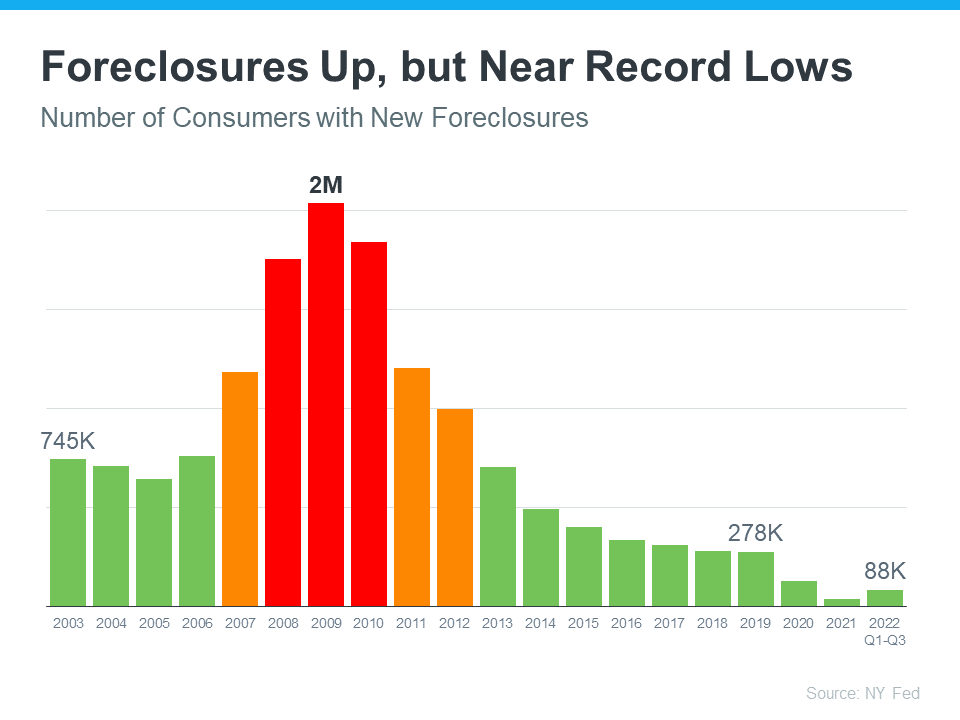
With that program, many were concerned it would result in a wave of foreclosures coming to the market. That fear didn't materialize. Data from the New York Fed shows there are still fewer foreclosures happening today than before the pandemic (see graph below):
That means, while there are more foreclosures now compared to last year (when foreclosures were paused), the number is still well below what the housing market has seen in a more typical year, like 2017-2019.
And most importantly, the number we're seeing now is still far below the number we saw during the market crash (shown in the red bars in the graph). The big takeaway? Don't let a headline in the news mislead you. While foreclosures are up year-over-year, historical context is essential to understanding the full picture.
Most Homeowners Have More Than Enough Equity To Sell Their Homes
Many homeowners today have enough equity to sell their homes instead of facing foreclosure. Due to rapidly rising home prices over the last two years, the average homeowner has gained record amounts of equity in their home. And if they've stayed in their homes even longer, they may have even more equity than they realize. As Ksenia Potapov, Economist at First American, says:
Homeowners have very high levels of tappable home equity today, providing a cushion to withstand potential price declines, but also preventing housing distress from turning into a foreclosure. . . the result will likely be more of a foreclosure ‘trickle' than a ‘tsunami.'
A recent report from ATTOM Data explains it by going even deeper into the numbers:
Only about 214,800 homeowners were facing possible foreclosure in the second quarter of 2022, or just four-tenths of one percent of the 58.2 million outstanding mortgages in the U.S. Of those facing foreclosure, about 195,400, or 91 percent, had at least some equity built up in their homes.
Bottom Line
If you see headlines about the increasing number of foreclosures today, remember context is important. While it's true the number of foreclosures is higher now than it was last year, foreclosures are still well below pre-pandemic years. If you have questions, let's connect.
|
|