That House That’s Been Sitting Could Be Your Best Shot at a Deal

BLOGJune 22, 2026


Open up a home search and you'll see them. Listings that have been on the market for two months. Three. Some longer.

Most buyers scroll right past them, assuming something’s wrong with the house. But that instinct could be costing you, since the longer a home sits, the more motivated the seller usually gets.

Where Some Buyers Are Finding Better Deals

If affordability has been your #1 hurdle to buying, here’s a surprisingly simple strategy that could help you finally get your foot in the door. Start with the homes that have been sitting the longest. That’s often where the best deals are.

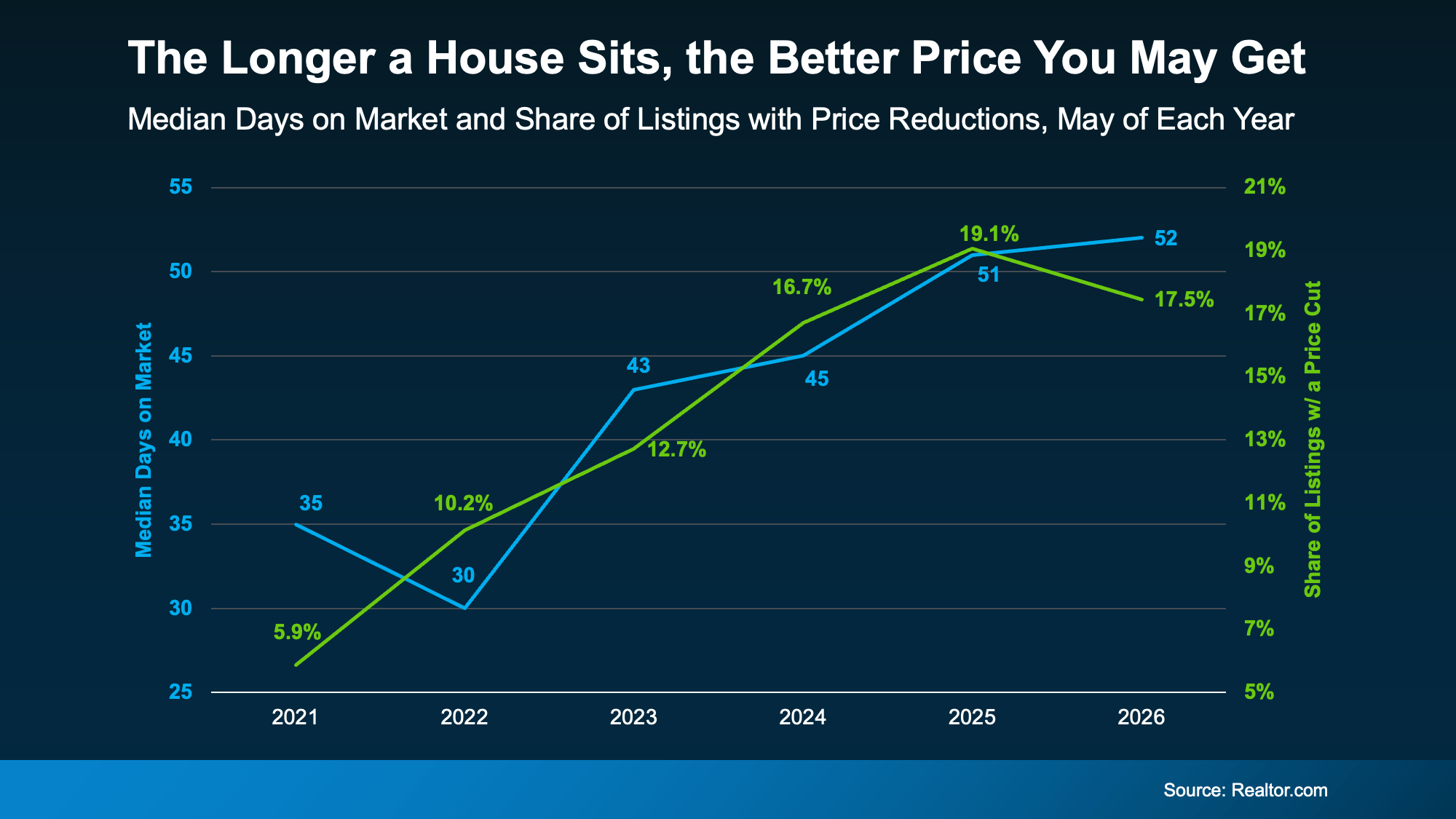
Here’s why. Data from Realtor.com shows there’s a connection between longer time on the market and lower sales prices. Basically, the longer a house sits, the more likely it is that the seller will reduce the price (see graph below):
a graph with numbers and lines

The blue line tracks how long homes stay on the market, while the green line tracks the share of homes getting a price reduction. As one climbs, so does the other.  

And if you focus on these homes that are just sitting and waiting, the opportunity for you is bigger than you may think right now.

Redfin data shows there’s $347 billion worth of stale listings on the market right now – more than ever before for this time of year. So, ask your agent to filter listings for you from oldest to newest. The home that fits your budget might already be there. Just further down the list than you thought.

Lingering Doesn’t Always Mean Something’s Wrong 

Let’s say you do that and something catches your eye. Still, you might be questioning why the home has been sitting in the first place. Just remember, sometimes it has nothing to do with the home itself.

According to Redfin, common causes are:

  • The asking price was set too high to start

  • The home didn’t show well online

  • There are a lot of homes for sale in the area, so it just got buried

So, nothing that’s necessarily a dealbreaker, or even anything that’s wrong with the home itself. If there’s a real issue, a thorough inspection will surface it. And that’s information you can use to negotiate. Not a reason to assume it’s a house worth skipping over.

How To Turn a Lingering Listing into a Win

So how do you capitalize on a lingering listing? According to USA Today, you have two main levers to pull.

The first is price. Work with your agent to study what comparable homes recently sold for, then build an offer around that. Coming in below asking price is fair game when a home has been sitting.

The second is concessions. If a seller won’t budge much on price, they may still help in other ways, like covering some closing costs, repair credits, or even a mortgage rate buydown that lowers your monthly payment.

A local agent has the context to tell which homes are the real opportunities and which are skippable.

Bottom Line

A house sitting on the market isn’t always a glaring red flag. In today’s market, it may be your best opportunity yet.

For help deciding which lingering listings are actually worth a second look, let’s connect.

The information contained, and the opinions expressed, in this article are not intended to be construed as investment advice. Keeping Current Matters, Inc. does not guarantee or warrant the accuracy or completeness of the information or opinions contained herein. Nothing herein should be construed as investment advice. You should always conduct your own research and due diligence and obtain professional advice before making any investment decision. Keeping Current Matters, Inc. will not be liable for any loss or damage caused by your reliance on the information or opinions contained herein.

Jan. 11, 2023

Today's Housing Market Is Nothing Like 15 Years Ago?

Today's Housing Market Is Nothing Like 15 Years Ago

Today's Housing Market Is
Nothing Like 15 Years Ago | MyKCM

There's no doubt today's housing market is very different than the frenzied one from the past couple of years. In the second half of 2022, there was a dramatic shift in real estate, and it caused many people to make comparisons to the 2008 housing crisis. While there may be a few similarities, when looking at key variables now compared to the last housing cycle, there are significant differences.

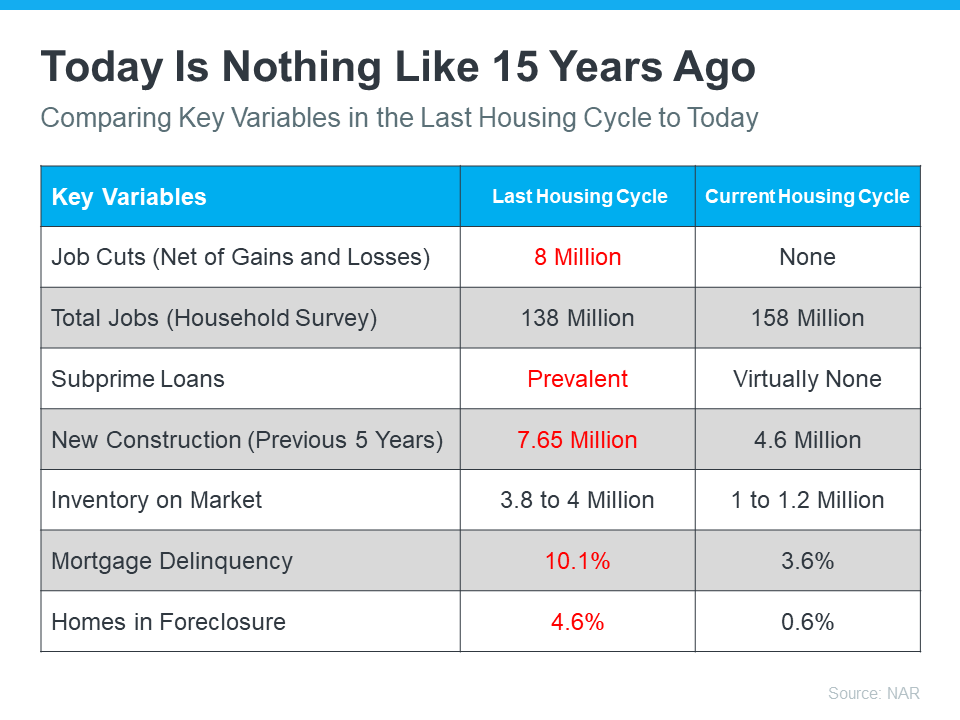
In the latest Real Estate Forecast Summit, Lawrence Yun, Chief Economist at the National Association of Realtors (NAR), drew the comparisons below between today's housing market and the previous cycle:

Today's Housing Market Is Nothing Like 15 Years Ago | MyKCM

Looking at the facts, it's clear: today is very different than the housing market of 15 years ago.

There's Opportunity in Real Estate Today

And in today's market, with inventory rising and less competition from other buyers, there's opportunity right now. According to David Stevens, former Assistant Secretary of Housing:

So be advised…this may be the one and only window for the next few years to get into a buyer's market. And remember…as the Federal Reserve data shows…home prices only go up and always recover from recessions no matter how mild or severe. Long term homeowners should view this market…right now…as a unique buying opportunity.

Bottom Line

Today's housing market is nothing like the real estate market 15 years ago. If you're a buyer right now, this may be the chance you've been waiting for.


Posted in Market Updates
Jan. 10, 2023

The Truth About Negative Home Equity Headlines?

The Truth About Negative Home Equity Headlines

The Truth About Negative
Home Equity Headlines | MyKCM

Home equity has been a hot topic in real estate news lately. And if you've been following along, you may have heard there's a growing number of homeowners with negative equityBut don't let those headlines scare you.

In truth, the headlines don't give you all the information you really need to understand what's happening and at what scale. Let's break down one of the big equity stories you may be seeing in the news, and what's actually taking place. That way, you'll have the context you need to understand the big picture.

Headlines Focus on Short-Term Equity Numbers and Fail To Convey the Long-Term View

One piece of news circulating focuses on the percentage of homes purchased in 2022 that are currently underwater. The term underwater refers to a scenario where the homeowner owes more on the loan than the house is worth. This was a huge issue when the housing market crashed in 2008, but it much less significant today.

Media coverage right now is based loosely on a report from Black Knight, Inc. The actual report from that source says this:

Of all homes purchased with a mortgage in 2022, 8% are now at least marginally underwater and nearly 40% have less than 10% equity stakes in their home, . . .

Let's unpack that for a moment and provide the bigger picture. The data-bound report from Black Knight is talking specifically about homes purchased in 2022, but media headlines don't always mention that timeframe or provide the surrounding context about how unusual of a year 2022 was for the housing market. In 2022, home price appreciation soared, and it reached its max around March-April. Since then, the rate of appreciation has been slowing down.

Homeowners who bought their house last year right at the peak or those who paid more than market value in the months that followed are more likely to fall into the category of being marginally underwater. The qualifier marginally is another key piece of the puzzle the media isn't necessarily including in their coverage.

So, what does that mean for those who purchased a home in 2022? It's important to remember, owning a home is a long-term investment, not a short-term play. When headlines focus on the short-term view, they're not necessarily providing the full context.

Typically speaking, the longer you stay in your home, the more equity you gain as you pay down your loan and as home prices appreciate. With recent market conditions, you may not have gained significant equity right away if you owned the home for just a few months. But it's also true that many homeowners who recently bought their house are unlikely to be looking to sell quite yet.

Bottom Line

As with everything, knowing the context is important. If you have questions about real estate headlines or about how much equity you have in your home, let's connect.


Posted in Market Updates
Jan. 9, 2023

What Experts Are Saying About the 2023 Housing Market?

What Experts Are Saying About the 2023 Housing Market

What Experts Are Saying
About the 2023 Housing Market | MyKCM

If you're thinking about buying or selling a home soon, you probably want to know what you can expect from the housing market this year. In 2022, the market underwent a major shift as economic uncertainty and higher mortgage rates reduced buyer demand, slowed the pace of home sales, and moderated home prices. But what about 2023?

An article from HousingWire offers this perspective:

The red-hot housing market of the past 2 ½ years was characterized by sub-three percent mortgage rates, fast-paced bidding wars and record-low inventory. But more recently, market conditions have done an about-face. . . . now is the opportunity for everyone to become re-educated about what a ‘typical' housing market looks like.

This year, experts agree we may see the return of greater stability and predictability in the housing market if inflation continues to ease and mortgage rates stabilize. Here's what they have to say.

The 2023 forecast from the National Association of Realtors (NAR) says:

While 2022 may be remembered as a year of housing volatility, 2023 likely will become a year of long-lost normalcy returning to the market, . . . mortgage rates are expected to stabilize while home sales and prices moderate after recent highs, . . .

Danielle Hale, Chief Economist at realtor.comadds:

. . . buyers will not face the extreme competition that was commonplace over the past few years.

Lawrence Yun, Chief Economist at NAR, explains home prices will vary by local area, but will net neutral nationwide as the market continues to adjust:

After a big boom over the past two years, there will essentially be no change nationally . . . Half of the country may experience small price gains, while the other half may see slight price declines.

Mark Fleming, Chief Economist at First American, says:

The housing market, once adjusted to the new normal of higher mortgage rates, will benefit from continued strong demographic-driven demand relative to an overall, long-run shortage of supply.

Bottom Line

If you're looking to buy or sell a home this year, the best way to ensure you're up to date on the latest market insights is to partner with a trusted real estate advisor. Let's connect.


Posted in Market Updates
Jan. 6, 2023

?Tips To Reach Your Homebuying Goals in 2023 [INFOGRAPHIC]

Tips To Reach Your Homebuying Goals in 2023 [INFOGRAPHIC]

Tips To Reach Your
Homebuying Goals in 2023 [INFOGRAPHIC] | MyKCM

Some Highlights

Posted in Market Updates
Jan. 4, 2023

Avoid the Rental Trap in 2023?

Avoid the Rental Trap in 2023

Avoid the Rental Trap in
2023 | MyKCM

If you're a renter, you likely face an important decision every year: renew your current lease, start a new one, or buy a home. This year is no different. But before you dive too deeply into your options, it helps to understand the true costs of renting moving forward.

In the past year, both current renters and new renters have seen their rent go up based on information from realtor.com:

Three out of four renters (74.2%) who have moved in the past 12 months reported seeing their rent increase. The strain from recent rent hikes isn't exclusive to renters who have recently moved. Nearly two-thirds of renters (63.2%) who have lived in their current rental between 12 and 24 months, and likely renewed their lease, have also reported increases in their rent.

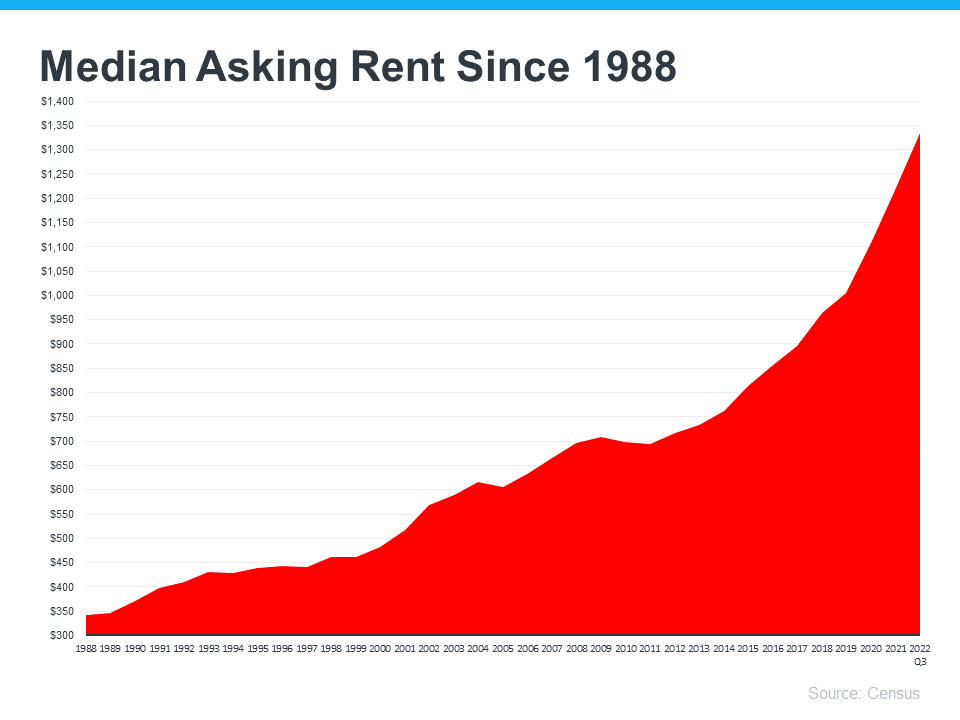
And if you look back at historical data, that shouldn't come as surprise. That's because, according to the Census, rents have been rising fairly consistently since 1988 (see graph below):

Avoid the Rental Trap in 2023 | MyKCM

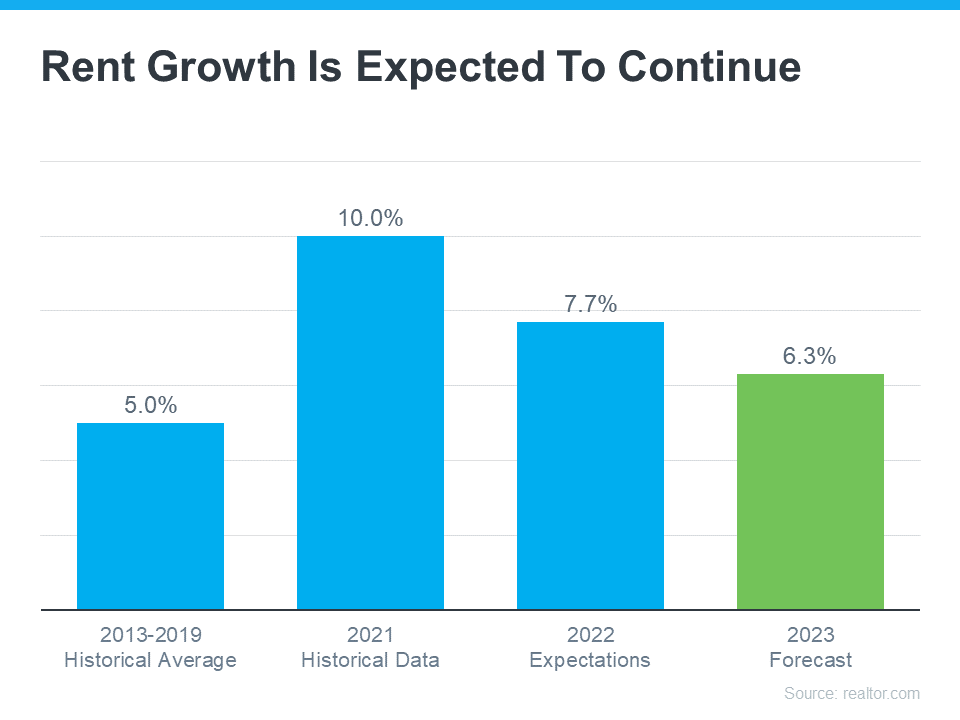
So, if you're considering renting as an option in 2023, it's worth weighing whether this trend is likely to continue. The 2023 Housing Forecast from realtor.com expects rents will keep climbing (see graph below):

Avoid the Rental Trap in 2023 | MyKCM

That forecast projects rents will increase by 6.3% in the year ahead (shown in green). When compared to the blue bars in the graph, it's clear that the 2023 projection doesn't call for an increase as drastic as the ones renters have seen over the past two years, but it's still above the historical average for rent hikes between 2013-2019.

That means, if you're planning to rent again this year and you've not yet renewed your lease, you may pay more when you do.

Homeownership Provides an Alternative to Rising Rents

These rising costs may make you reconsider what other alternatives you have. If you’re looking for more stability, it could be time to prioritize homeownership. One of the many benefits of owning your own home is it provides a stable monthly cost that you can lock in for the duration of your loan. As Freddie Mac says:

Monthly rent payments may increase over time, but a fixed-rate mortgage will ensure that you’re paying the same amount each month. With a fixed-rate mortgage, your interest rate is locked in for the life of loan. Steady payments allow you to budget wisely and make plans for the future.

If you're planning to make a move this year, locking in your monthly housing costs for the duration of your loan can be a major benefit. You'll avoid wondering if you'll need to adjust your budget to account for annual increases like you would if you left your housing payment up to your landlord and their renewal cycle.

Homeowners also enjoy the added benefit of home equity, which has grown substantially. In fact, the latest Homeowner Equity Insight report from CoreLogic shows the average homeowner gained $34,300 in equity over the last 12 months. As a renter, your rent payment only covers the cost of your dwelling. When you pay your mortgage on a house, you grow your wealth through the forced savings that is your home equity.

Bottom Line

If you're thinking of renting this year, it's important to keep in mind the true costs you'll face. Let's chat to see how you can begin your journey to homeownership today.


Posted in Market Updates
Jan. 3, 2023

Wondering How Much You Need To Save for a Down Payment??

Wondering How Much You Need To Save for a Down Payment?

Wondering How Much You Need
To Save for a Down Payment? | MyKCM

If you're getting ready to buy your first home, you're likely focused on saving up for everything that purchase involves. One cost that's likely top of mind is your down payment. But don’t let a common misconception about how much you need to save make the process harder than it could be.

Understand 20% Isn't Always the Typical Down Payment

Freddie Mac explains:

. . . nearly a third of prospective homebuyers think they need a down payment of 20% or more to buy a home. This myth remains one of the largest perceived barriers to achieving homeownership.

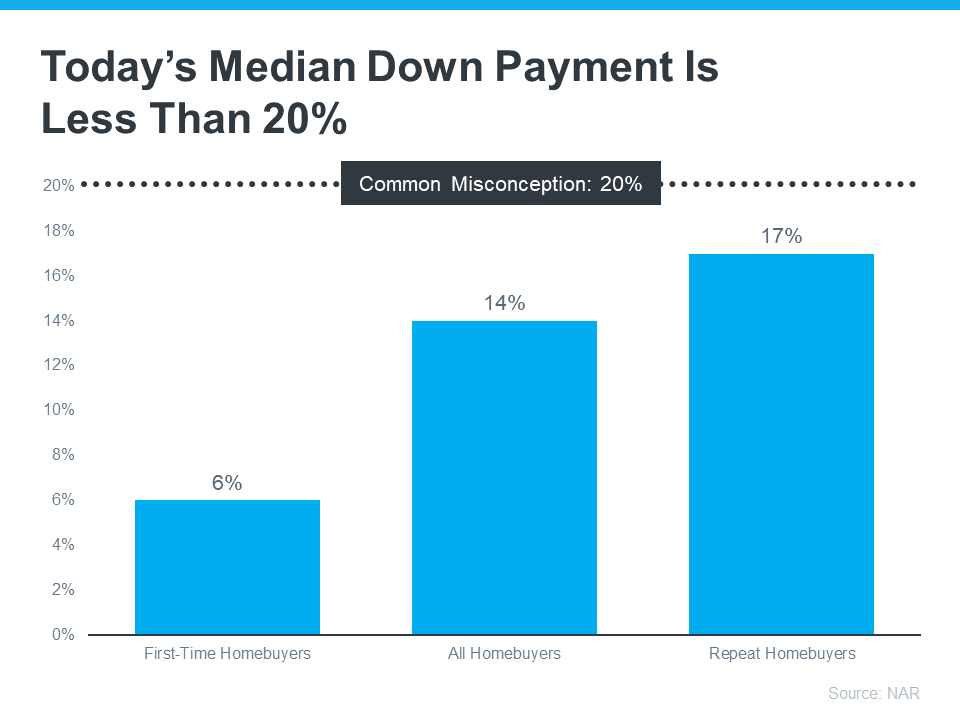
Unless specified by your loan type or lender, it's typically not required to put 20% down. This means you could be closer to your homebuying dream than you realize. According to the National Association of Realtors (NAR), the median down payment hasn't been over 20% since 2005. In fact, the median down payment today is only 14%. And it's even lower for first-time homebuyers at just 6% (see graph below):

Wondering How Much You Need To Save for a Down Payment? | MyKCM

Learn About Options That Can Help You Toward Your Goal

If saving for a down payment still feels like a challenge, know that there's help available. A real estate professional and trusted lender can show you options that could help you get closer to your down payment goal. According to latest Homeownership Program Index from Down Payment Resource, there are over 2,000 homebuyer assistance programs in the U.S., and the majority are intended to help with down payments.

Plus there are even loan types, like FHA loans, with down payments as low as 3.5%, as well as options like VA loans and USDA loans with no down payment requirements for qualified applicants.

To understand your options, be sure to do your homework. If you're interested in learning more about down payment assistance programs, information is available through sites like Down Payment Resource. Then, partner with a trusted lender to learn what you qualify for on your homebuying journey.

Bottom Line

Remember, a 20% down payment isn't always required. If you want to purchase a home this year, let's connect. You'll also want to make sure you have a trusted lender so you can explore your down payment options.


Posted in Market Updates
Dec. 30, 2022

Here's to a Wonderful 2023!

Posted in Market Updates
Dec. 29, 2022

Planning To Sell Your House? It's Critical To Hire a Pro.?

Planning To Sell Your House? It's Critical To Hire a Pro.

Planning To Sell Your
House? It's Critical To Hire a Pro | MyKCM

With higher mortgage rates and moderating buyer demand, conditions in the housing market are different today. And if you're thinking of selling your house, it's important to understand how the market has changed and what that means for you. The best way to make sure you're in the know is to work with a trusted housing market expert.

Here are five reasons working with a professional can ensure you'll get the most out of your sale.

1. A Real Estate Advisor Is an Expert on Market Trends

Leslie Rouda Smith, 2022 President of the National Association of Realtors (NAR), explains:

“During challenging and changing market conditions, one thing that’s calming and constant is the assurance that comes from a Realtor® being in your corner through every step of the home transaction. Consumers can rely on Realtors®’ unmatched work ethic, trusted guidance and objectivity to help manage the complexities associated with the home buying and selling process.

An expert real estate advisor has the latest information about national trends and your local area too. More importantly, they'll know what all of this means for you so they'll be able to help you make a decision based on trustworthy, data-bound information.

2. A Local Professional Knows How To Set the Right Price for Your House

Home price appreciation has moderated this year. If you sell your house on your own, you may be more likely to overshoot your asking price because you're not as aware of where prices are today. If you do, you run the risk of deterring buyers or seeing your house sit on the market for longer.

Real estate professionals provide an unbiased eye when they help you determine a price for your house. They'll use a variety of factors, like the condition of your home and any upgrades you've made, and compare your house to recently sold homes in your area to find the best price for today's market. These steps are key to making sure it's set to move as quickly as possible.

3. A Real Estate Advisor Helps Maximize Your Pool of Buyers

Since buyer demand has cooled this year, you’ll want to do what you can to help bring in more buyers. Real estate professionals have a large variety of tools at their disposal, such as social media followers, agency resources, and the Multiple Listing Service (MLS) to ensure your house gets in front of people looking to make a purchase. Investopedia explains why it's risky to sell on your own without the network an agent provides:

You don't have relationships with clients, other agents, or a real estate agency to bring the largest pool of potential buyers to your home.

Without access to the tools and your agent's marketing expertise, your buyer pool – and your home's selling potential – is limited.

4. A Real Estate Expert Will Read – and Understand – the Fine Print

Today, more disclosures and regulations are mandatory when selling a house. That means the number of legal documents you'll need to juggle is growing. NAR explains it like this:

Selling a home typically requires a variety of forms, reports, disclosures, and other legal and financial documents. . . . Also, there's a lot of jargon involved in a real estate transaction; you want to work with a professional who can speak the language.

A real estate professional knows exactly what all the fine print means and how to work through it efficiently. They'll help you review the documents and avoid any costly missteps that could occur if you try to handle them on your own.

5. A Trusted Advisor Is a Skilled Negotiator

In today's market, buyers are also regaining some negotiation power as bidding wars ease. If you sell without a professional, you'll also be responsible for any back-and-forth. That means you'll have to coordinate with:

  • The buyer, who wants the best deal possible
  • The buyer's agent, who will use their expertise to advocate for the buyer
  • The inspection company, which works for the buyer and will almost always find concerns with the house
  • The appraiser, who assesses the property's value to protect the lender

Instead of going toe-to-toe with all the above parties alone, lean on an expert. They'll know what levers to pull, how to address everyone's concerns, and when you may want to get a second opinion.

Bottom Line

Don't go at it alone. If you're planning to sell your house this winter, let's connect so you have an expert by your side to guide you in today's market.

Posted in Market Updates
Dec. 27, 2022

Confused About What's Going on in the Housing Market? Lean on a Professional.?

Confused About What's Going on in the Housing Market? Lean on a Professional.

Confused About What's Going
on in the Housing Market? Lean on a Professional. | MyKCM

If you're thinking about buying or selling a home, you probably want to know what's really happening with home prices, mortgage rates, housing supply, and more. That's not an easy task considering how sensationalized headlines are today. Jay Thompson, Real Estate Industry Consultant, explains:

Housing market headlines are everywhere. Many are quite sensational, ending with exclamation points or predicting impending doom for the industry. Clickbait, the sensationalizing of headlines and content, has been an issue since the dawn of the internet, and housing news is not immune to it.

Unfortunately, when information in the media isn't clear, it can generate a lot of fear and uncertainty in the market. As Jason Lewris, Cofounder and Chief Data Officer at Parclsays:

In the absence of trustworthy, up-to-date information, real estate decisions are increasingly being driven by fear, uncertainty, and doubt.

But it doesn't have to be that way. Buying or selling a home is a big decision, and it should be one you feel confident making. To help you separate fact from fiction and get the answers you need, lean on a local real estate advisor.

A trusted expert is your best resource to understand what's happening at the national and local levels. They'll be able to debunk the headlines using data you can trust. And using their in-depth knowledge of the industry, they'll provide context so you know how current trends compare to the normal ebbs and flows in the industry, historical data and more.

Then, to make sure you have the full picture, they'll tell you if your local area is following the national trend or if they're seeing something different in your market. Together, you'll use all of that information to make the best possible decision for you.

After all, making a move is a potentially life-changing milestone. It should be something you feel ready for and excited about. And that's where an agent comes in.

Bottom Line

If you have questions about the headlines or what's happening in the housing market today, let's connect so you have expert insights and advice on your side.


Posted in Market Updates
Dec. 27, 2022

Financial Fundamentals for First-Time Homebuyers?

Financial Fundamentals for First-Time Homebuyers

Financial Fundamentals for
First-Time Homebuyers | MyKCM

Are you prepping to buy your first home? If so, one of the steps you should take early on is making sure you're financially ready for your purchase. Here are just a few of the financial fundamentals you'll need to focus on as you set out to buy a home.

Build Your Credit

Your credit is one element that helps determine which home loan you'll qualify for. It also impacts your mortgage interest rate. While there are many factors that go into your mortgage application, a higher credit score could lead to a lower monthly payment in the long run.

So how do you make sure your credit is in the best shape possible when it's time to buy? A recent article from NerdWallet lists a few tips you can use as you work to build and strengthen your credit. They include:

  • Tracking your credit and disputing any errors that show up on your reports.
  • Paying your bills on time. This includes making loan payments and paying down any open lines of credit.
  • Keeping your credit card balances low. Paying more than your minimum monthly balance when you're able can help.

Automate Your Savings for Your House Fund

You might also be wondering how you can achieve your down payment savings goals. Bankrate provides buyers with a number of tips to help you save, including searching for down payment assistance programs and ways you can save more, faster. As the article says:

One of the best ways to save for anything — including a down payment — is to set it and forget it. If you receive a regular paycheck, ask your employer to direct a portion of that payment into a savings account. If you're a freelance worker or independent contractor, set up a recurring transfer from a checking account to a savings account to establish the routine.

Get Pre-Approved

As you prepare for your purchase, you'll also need to have a good grasp on your budget and how much you'll be able to borrow for your home loan. That's where the pre-approval process comes in.

Pre-approval from a lender lets you know how much money you can borrow for your home loan. And having that knowledge, plus an understanding of your savings, can help you decide on your target price range for a house.

From there, you can start browsing for houses online and see what's available in your area in that general price point. This can help you really understand your options so you can start to picture your future home.

For Customized Advice, Build a Team of Professionals

Finally, the best way to make you're prepared for your purchase is to connect with trusted real estate professionals. Having expert advisors in the industry will help you make strong decisions throughout the homebuying process based on your specific goals, finances, and situation. They know the market and can guide you toward the home of your dreams.

Bottom Line

If you're ready to get the homebuying process started, let's connect so you can begin to build your team of professionals today.


Posted in Market Updates