The Power of Mortgage Pre-Approval [INFOGRAPHIC]
|
Some Highlights
|
![The Power of Mortgage
Pre-Approval [INFOGRAPHIC] | MyKCM](https://ecp.yusercontent.com/mail?url=https%3A%2F%2Ffiles.mykcm.com%2F2021%2F05%2F06093925%2F20210507-MEM-403x600.png&t=1620399762&ymreqid=fa91d6a0-6d01-c85b-1ccd-930018016900&sig=wc4vUj14lPX73rokK6JKwQ--~D)

Open up a home search and you'll see them. Listings that have been on the market for two months. Three. Some longer.
Most buyers scroll right past them, assuming something’s wrong with the house. But that instinct could be costing you, since the longer a home sits, the more motivated the seller usually gets.
If affordability has been your #1 hurdle to buying, here’s a surprisingly simple strategy that could help you finally get your foot in the door. Start with the homes that have been sitting the longest. That’s often where the best deals are.
Here’s why. Data from Realtor.com shows there’s a connection between longer time on the market and lower sales prices. Basically, the longer a house sits, the more likely it is that the seller will reduce the price (see graph below):
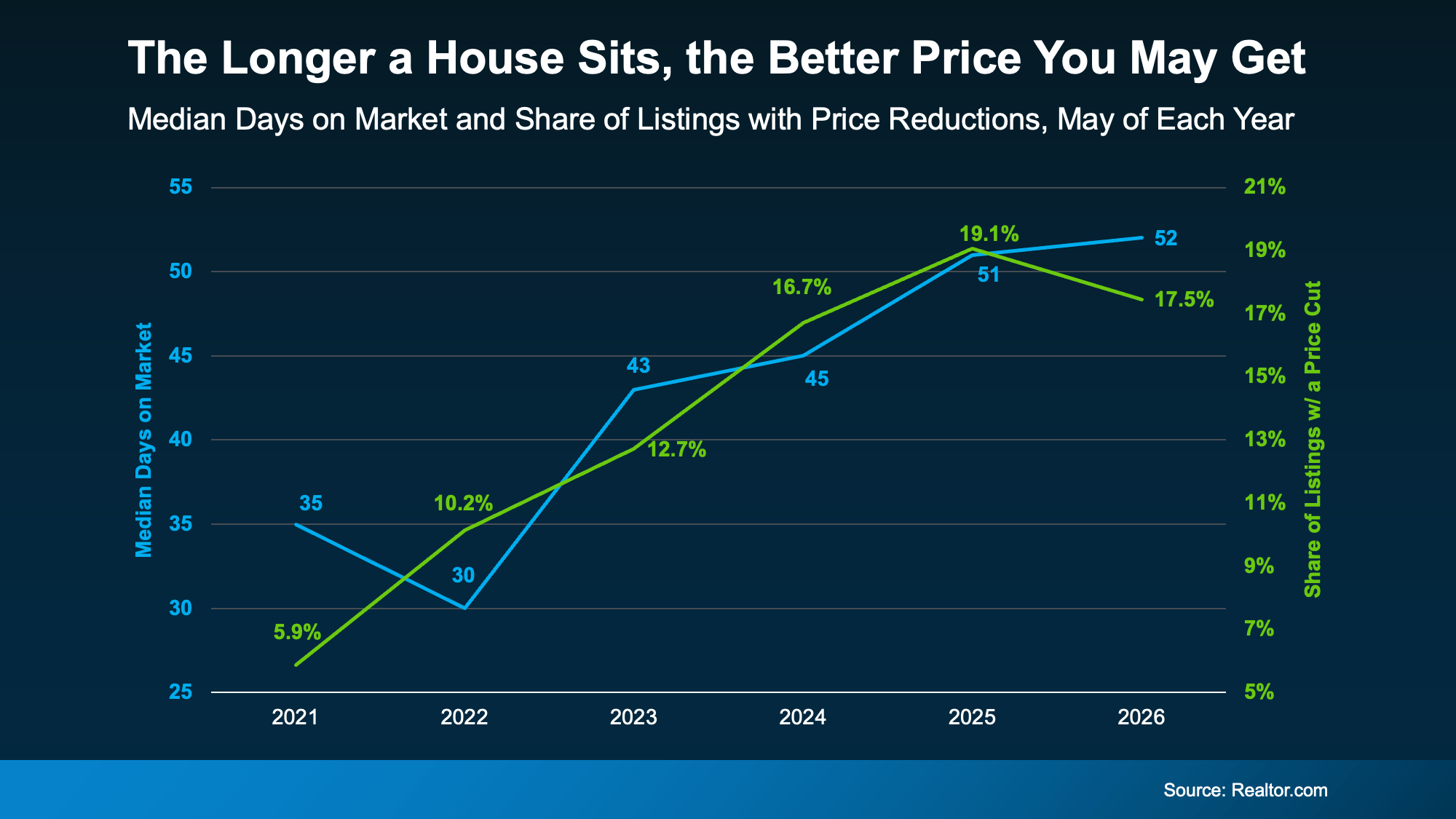
The blue line tracks how long homes stay on the market, while the green line tracks the share of homes getting a price reduction. As one climbs, so does the other.
And if you focus on these homes that are just sitting and waiting, the opportunity for you is bigger than you may think right now.
Redfin data shows there’s $347 billion worth of stale listings on the market right now – more than ever before for this time of year. So, ask your agent to filter listings for you from oldest to newest. The home that fits your budget might already be there. Just further down the list than you thought.
Let’s say you do that and something catches your eye. Still, you might be questioning why the home has been sitting in the first place. Just remember, sometimes it has nothing to do with the home itself.
According to Redfin, common causes are:
The asking price was set too high to start
The home didn’t show well online
There are a lot of homes for sale in the area, so it just got buried
So, nothing that’s necessarily a dealbreaker, or even anything that’s wrong with the home itself. If there’s a real issue, a thorough inspection will surface it. And that’s information you can use to negotiate. Not a reason to assume it’s a house worth skipping over.
So how do you capitalize on a lingering listing? According to USA Today, you have two main levers to pull.
The first is price. Work with your agent to study what comparable homes recently sold for, then build an offer around that. Coming in below asking price is fair game when a home has been sitting.
The second is concessions. If a seller won’t budge much on price, they may still help in other ways, like covering some closing costs, repair credits, or even a mortgage rate buydown that lowers your monthly payment.
A local agent has the context to tell which homes are the real opportunities and which are skippable.
A house sitting on the market isn’t always a glaring red flag. In today’s market, it may be your best opportunity yet.
For help deciding which lingering listings are actually worth a second look, let’s connect.
The information contained, and the opinions expressed, in this article are not intended to be construed as investment advice. Keeping Current Matters, Inc. does not guarantee or warrant the accuracy or completeness of the information or opinions contained herein. Nothing herein should be construed as investment advice. You should always conduct your own research and due diligence and obtain professional advice before making any investment decision. Keeping Current Matters, Inc. will not be liable for any loss or damage caused by your reliance on the information or opinions contained herein.
|
Some Highlights
|
|
Many people are sitting on the fence trying to decide if now's the time to buy a home. Some are renters who have a strong desire to become homeowners but are unsure if buying right now makes sense. Others may be homeowners who are realizing that their current home no longer fits their changing needs. To determine if they should buy now or wait another year, they both need to ask two simple questions:
Let's shed some light on the answers to these questions. Where will home prices be a year from now?If you average the most recent projections from the major industry forecasters, the expectation is home prices will increase by 7.7%. Let's take a house that's valued today at $325,000 as an example. If the buyer makes a 10% down payment ($32,500), they'll end up borrowing $292,500 for their mortgage. Applying the projected rate of home price appreciation, that same house will cost $350,025 next year. With a 10% down payment ($35,003), they'd then have to borrow $315,022. Therefore, as a result of rising home prices alone, a prospective buyer will have to put down an additional $2,503 and borrow an additional $22,523 just for waiting a year to make their move. Where will mortgage rates be a year from now?Today, mortgage rates are hovering around 3%. However, most experts believe they'll rise as the economy continues to recover. Any increase in the mortgage rate will also increase a purchaser's cost. Here are the forecasts for the first quarter of 2022 from four major entities:
The projections average out to 3.6% among these four forecasts, a jump up from where they are today. What does it mean to you if home values and mortgage rates increase?A buyer will pay a lot more in mortgage payments each month if both of these variables increase. Assuming a buyer purchases a $325,000 home this year with a 30-year fixed-rate loan at 3% after making a 10% down payment, their monthly principal and interest payment would be $1,233. That same home one year from now could be $350,025, and the mortgage rate could be 3.6% (based on the industry forecasts mentioned above). That monthly principal and interest payment, after putting down 10%, totals $1,432. The difference in the monthly mortgage payment would be $199. That's $2,388 more per year and $71,640 over the life of the loan. Add to that the approximately $25,000 a house with a similar value would build in home equity this year as a result of home price appreciation, and the total net worth increase a purchaser could gain by buying this year is nearly $100,000. That's a small fortune. Bottom LineWhen asking if they should buy a home, many potential buyers think of the nonfinancial benefits of owning a home. When asking when to buy, the financial benefits make it clear that doing so now is much more advantageous than waiting until next year.
|
|
So far this year, mortgage rates continue to hover around 3%, encouraging many hopeful homebuyers to enter the housing market. However, there's a good chance rates will increase later this year and going into 2022, ultimately making it more expensive to borrow money for a home loan. Here's a look at what several experts have to say. Danielle Hale, Chief Economist, realtor.com:
Lawrence Yun, Chief Economist, National Association of Realtors (NAR):
Freddie Mac:
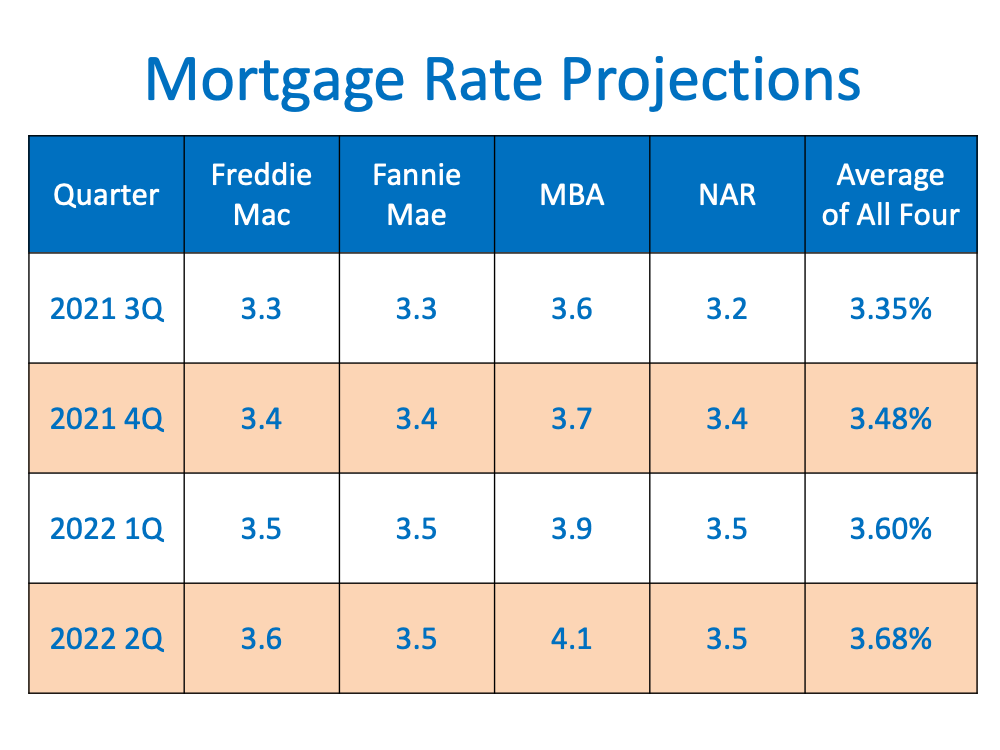
Below are the most recent mortgage rate forecasts from four top authorities – Freddie Mac, Fannie Mae, the Mortgage Bankers Association (MBA), and NAR: Bottom LineIf you're planning to buy a home, purchasing before mortgage interest rates rise may help you save significantly over the life of your home loan.
|
|
The housing market keeps sailing along. The only headwind that could take it off course is the lack of inventory for sale. The National Association of Realtors (NAR) reports that there were 410,000 fewer single-family homes for sale this March than in March of 2020. The key to continued success in the residential housing market is for more listings to come on the market. However, many homeowners are concerned that selling their homes could be challenging for several reasons. Recently, Homes.com released the findings of a survey that identified these concerns, as well as what it will take for homeowners to feel comfortable selling their houses. Here are the four major homeowner concerns and a quick explanation of what's actually happening in the housing market today. 1. Homeowners don't know if they'll be able to secure their next home before selling.In negotiations, leverage is the power that one side may have to influence the other side while moving closer to their negotiating position. A party's leverage is based on the ability to award benefits or eliminate costs on the other side. In today's market, buyers have compelling reasons to purchase a home now:
These buyer needs give the seller tremendous leverage. Most already realize this leverage enables the homeowner to sell at a good price. However, this leverage may also be used to negotiate time to find their next home. The homeowner could sell their home to the buyer at today's price, which will enable the purchaser to take advantage of current mortgage rates. In return, the buyer might lease the house back to the seller for a pre-determined length of time while the seller finds a new home or has one built. This gives the buyer what they want while also giving the seller what they need. It's a true win-win negotiation. 2. Homeowners don't know if their current home will sell for the asking price or top market price.This is the perfect time to maximize profits while selling a house. NAR just released a study showing that bidding wars are at an all-time high. The study reveals that when comparing the first quarter of last year to the first quarter of this year, the number of offers on homes for sale doubled from an average of 2.4 to 4.8 offers. Whenever there's a bidding war, the price of the item for sale escalates. Bloomberg recently reported:
If a seller is looking for a top-dollar sale, there's no better time to sell than right now. 3. Homeowners don't know if they will get an offer without their home requiring work or updates.Again, leverage is the greatest strength a seller has in this market. Due to the lack of homes for sale, many buyers are more willing to take on home improvement projects themselves in order to get the home they're after. A recent post on whether or not to renovate before selling notes:
If a seller is worried about doing work or updates on their home, they must realize that today's historically low inventory likely renders these projects less critical to the sale of the house. 4. Homeowners don't know if they can have a quick closing process.When speed is important, there are two points sellers should look at:
In the latest Existing Home Sales Report, NAR explains:
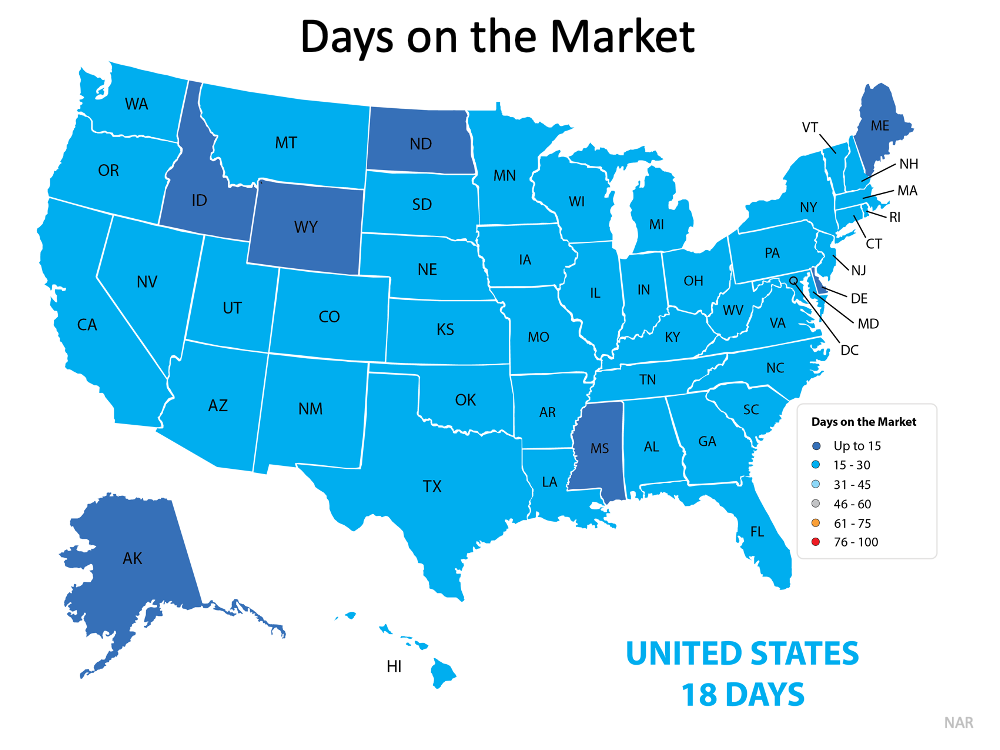
Eighteen days is fast, and it's a new record. Here are the days the average house is on the market in each state: If a mortgage is necessary, the most recent Origination Insight Report from Ellie Mae shows:
If you're looking for a quick closing process, there's never been a market in which the two-step process (finding a buyer and closing the deal) has taken less time. Bottom LineSelling your house can be daunting, especially in a fast-paced market. However, the fact that we're in such a strong sellers' market clearly eliminates many common concerns. Let's connect today so you can learn more about the opportunities for homeowners who are ready to sell.
|
Americans Find the Nonfinancial Benefits of Homeownership Most Valuable

Homeownership is a foundational part of the American Dream. As we look back on more than a year of sheltering in our homes, having a place of our own is more important than ever. While financial benefits are always a key aspect of homeownership, today, homeowners rank the nonfinancial and personal benefits with even higher value.
Recently, two national surveys revealed the reasons homeownership is such an important part of life. The top three personal benefits of homeownership noted by respondents in Unison's 2021 report on The State of the American Homeowner are:
- 91% – feel secure, stable, or successful owning a home
- 70% – feel emotionally attached to the homes that have kept them safe over the past year
- 51% – call homeownership a “key part of their life
These sentiments were supported by the most recent National Housing Survey from Fannie Mae, which also shows that the top three reasons Americans value homeownership have nothing to do with money. Those surveyed were given a list of feelings and accomplishments that are associated with or impacted by where we live. They were then asked, To achieve this, are you better off owning or better off renting? Here are the top three points from the list that respondents said homeownership could help them achieve:
- 91% – control over what you do with your living space
- 90% – a sense of privacy and security
- 89% – a good place for your family to raise your children
Other nonfinancial advantages of homeownership revealed by the survey include feeling engaged in a community, having flexibility in future decisions, and experiencing less stress.
Bottom Line
Financial and nonfinancial benefits are a key component to the value of homeownership, but the nonfinancial side is most valued after a year full of pandemic-driven challenges. Let's connect today if you're ready to take the first steps toward becoming a homeowner.
|
|
|
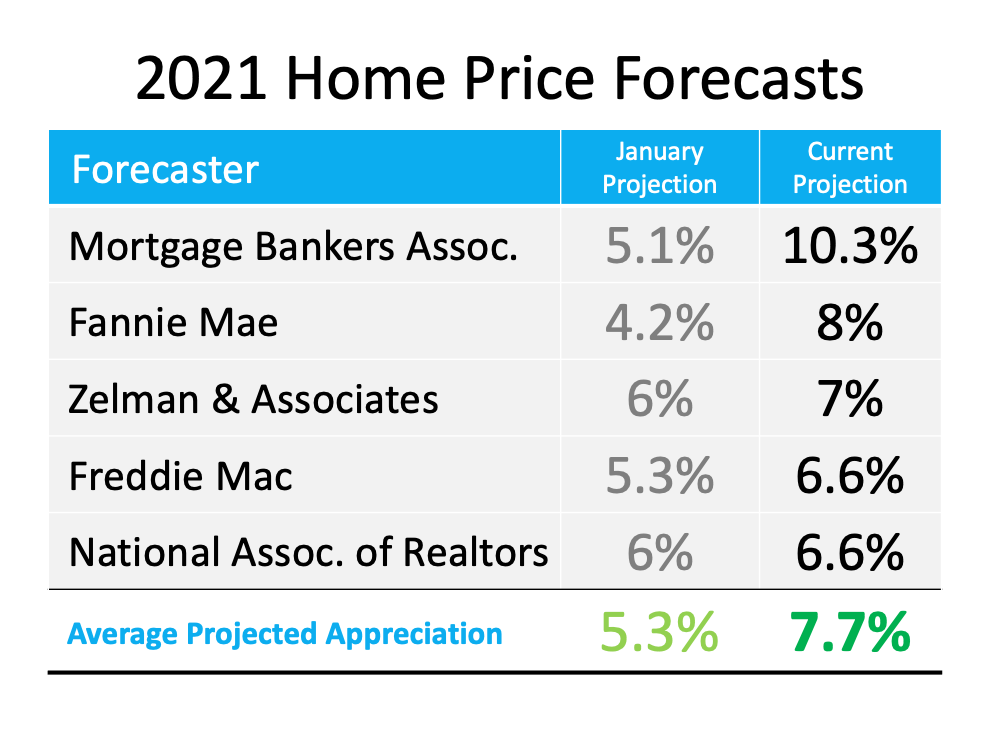
At the beginning of the year, industry forecasts called for home price appreciation to slow to about half of the double-digit increase we saw last year. The thinking was that inventory would increase from record-low levels and put an end to the bidding wars that have driven home prices up over the past twelve months. However, that increase in inventory has yet to materialize. The National Association of Realtors (NAR) reports that there are currently 410,000 fewer single-family homes available for sale than there were at this time last year. This has forced those who made appreciation forecasts this past January to amend those projections. The Mortgage Bankers Association, Fannie Mae, Freddie Mac, the National Association of Realtors, and Zelman & Associates have all adjusted their numbers upward after reviewing first quarter housing data. Here are their original forecasts and their newly updated projections: Bottom LineEntering 2021, there was some speculation that we might see price appreciation slow dramatically this year. Today, experts believe that won't be the case. Home values will remain strong throughout the year. |

Will the Housing Market Maintain Its Momentum?

Last week's Existing Home Sales Report from the National Association of Realtors (NAR) shows sales have dropped by 3.7% compared to the month before. This is the second consecutive month that sales have slumped. Some see this as evidence that the red-hot real estate market may be cooling. However, there could also be a simple explanation as to why existing home sales have slowed – there aren't enough homes to buy. There are currently 410,000 fewer single-family homes available for sale than there were at this time last year.
Lawrence Yun, Chief Economist at NAR, explains in the report:
“The sales for March would have been measurably higher, had there been more inventory. Days-on-market are swift, multiple offers are prevalent, and buyer confidence is rising.”
Yun's insight was supported the next day when the Census Bureau released its Monthly New Residential Sales Report. It shows that newly constructed home sales are up 20.7% over the previous month.
Buyer demand remains strong. With more of the adult population becoming vaccinated and job creation data showing encouraging signs, existing-home inventory is expected to grow in the coming months.
What will this mean for home sales going forward?
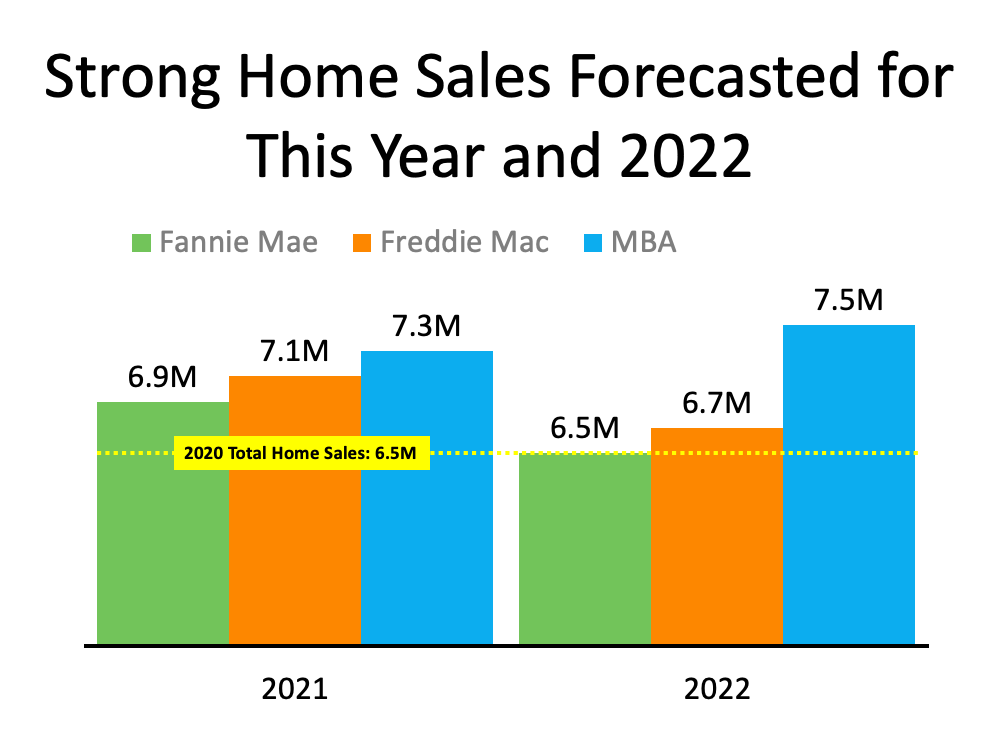
Fannie Mae, Freddie Mac, and the Mortgage Bankers Association (MBA) have all forecasted that total home sales (existing homes and new construction) will continue their momentum both this year and next. Here's a graph showing those projections:
Bottom Line
Living through a pandemic has caused many to re-evaluate the importance of a home and the value of homeownership. The residential real estate market will benefit from both as we move forward.
|
|
|
Homeowners ready to make a move are definitely in a great position to sell today. Housing inventory is incredibly low, driving up buyer competition. This gives homeowners leverage to sell for the best possible terms, and it's fueling a steady rise in home prices. In such a hot market, houses are selling quickly. According to the National Association of Realtors (NAR), homes are typically on the market for just 18 short days. Despite the speed and opportunity for sellers, there are still steps you can take to prep your house to shine so you get the greatest possible return. 1. Make Buyers Feel at HomeOne of the ways to make this happen is to take time to declutter. Pack away any personal items like pictures, awards, and sentimental belongings. The more neutral and tidy the space, the easier it is for a buyer to picture themselves living there. According to the 2021 Profile of Home Staging by NAR:
Not only will your house potentially attract the attention of more buyers and likely sell quickly, but the same report also notes:
As Jessica Lautz, Vice President of Demographics and Behavior Insights for NAR, says:
2. Keep It CleanOn top of making an effort to declutter, it's important to keep your house neat and clean. Before a buyer stops by, be sure to pick up toys, make the beds, and wash the dishes. This is one more way to reduce the number of things that can distract a buyer from the appeal of the home. Ensure your home smells fresh and clean as well. Buyers will remember the smell of your house, and according to the same report from NAR, the kitchen is one of the most important rooms of the house to focus on if you want to attract more buyers. 3. Give Buyers AccessBuyers are less likely to make an offer on your house if they aren't able to easily schedule a time to check it out. If your home is available anytime, that opens up more opportunities for multiple buyers to go from curious to eager. It also allows buyers on tight schedules to still get in to see your house. While health continues to be a great concern throughout the country, it's important to work with your agent to find the best safety measures and digital practices for your listing. This will drive visibility and create access options that also keep everyone in the process safe. 4. Price It RightEven in a sellers' market, it's crucial to set your house at the right price to maximize selling potential. Pricing your house too high is actually a detriment to the sale. The goal is to drive high attention from competing buyers and let bidding wars push the final sales price up. Work with your trusted real estate professional to determine the best list price for your house. Having an expert on your side in this process is truly essential. Bottom LineIf you want to sell on your terms, in the least amount of time, and for the best price, today's market sets the stage to make that happen. Let's connect today to determine the best ways to maximize the sale of your house this year.
|
|
Some Highlights
|

|
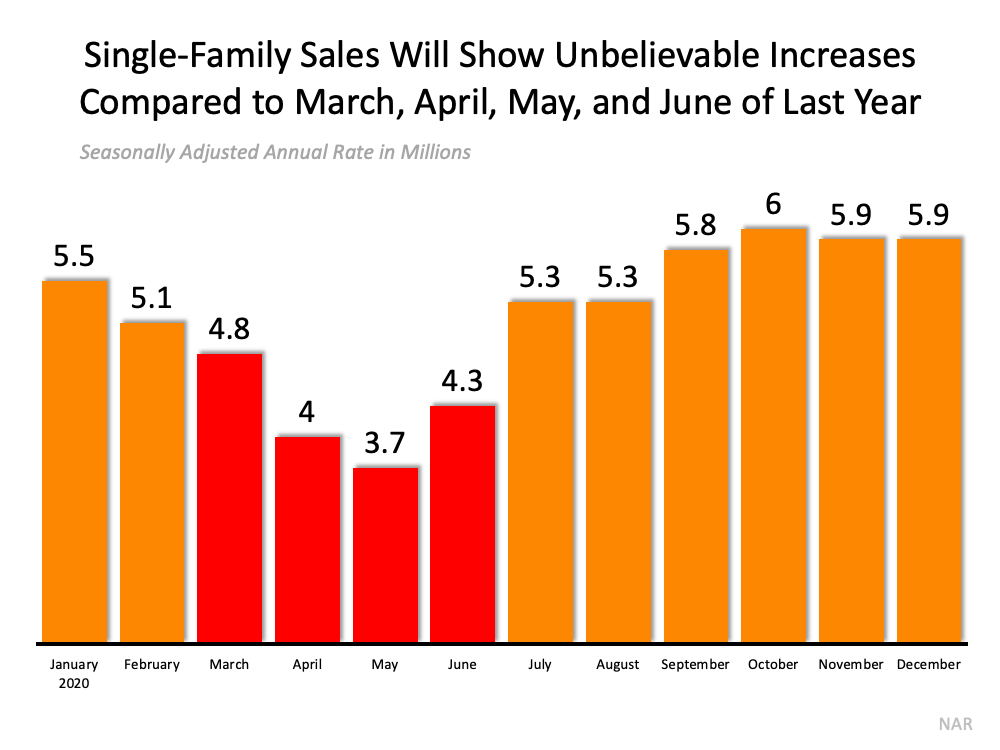
Don't be impressed by the headlines reporting year-over-year housing numbers for the next several months (data covering March, April, May, and June). The data will most likely show eye-popping one-year increases. While the year-over-year jumps will certainly be striking, consumers should take these numbers with a grain of salt, as the situation highlights a short-term quirk in the reporting of this data. Essentially, the increases will reflect a combination of two things: sharply lower housing numbers during last year's virus-related market collapse and the subsequent strong rebound. This will result in what will appear to be unbelievable growth. Let's use single-family home sales as an example: This spring's real estate market will bounce back with more normal seasonal sales increases. The percentage increase in sales will be astronomical – not because sales have skyrocketed, but instead because they will be compared to last year's low numbers. Bottom LineThere are likely to be some sensational headlines about real estate over the coming months. However, don't be fooled. The actual story is that the real estate market is finally back to normal. |





![This Isn't a Bubble. It's
Simply Lack of Supply. [INFOGRAPHIC] | MyKCM](https://ecp.yusercontent.com/mail?url=https%3A%2F%2Ffiles.mykcm.com%2F2021%2F04%2F22135919%2F20210423-MEM-421x600.png&t=1619190039&ymreqid=fa91d6a0-6d01-c85b-1c5d-f90023010700&sig=2oa3VeynZKwRO4OiOak_7Q--~D)