Why a Home Inspection Is Important [INFOGRAPHIC]
|
Some Highlights
|
Open up a home search and you'll see them. Listings that have been on the market for two months. Three. Some longer.
Most buyers scroll right past them, assuming something’s wrong with the house. But that instinct could be costing you, since the longer a home sits, the more motivated the seller usually gets.
If affordability has been your #1 hurdle to buying, here’s a surprisingly simple strategy that could help you finally get your foot in the door. Start with the homes that have been sitting the longest. That’s often where the best deals are.
Here’s why. Data from Realtor.com shows there’s a connection between longer time on the market and lower sales prices. Basically, the longer a house sits, the more likely it is that the seller will reduce the price (see graph below):
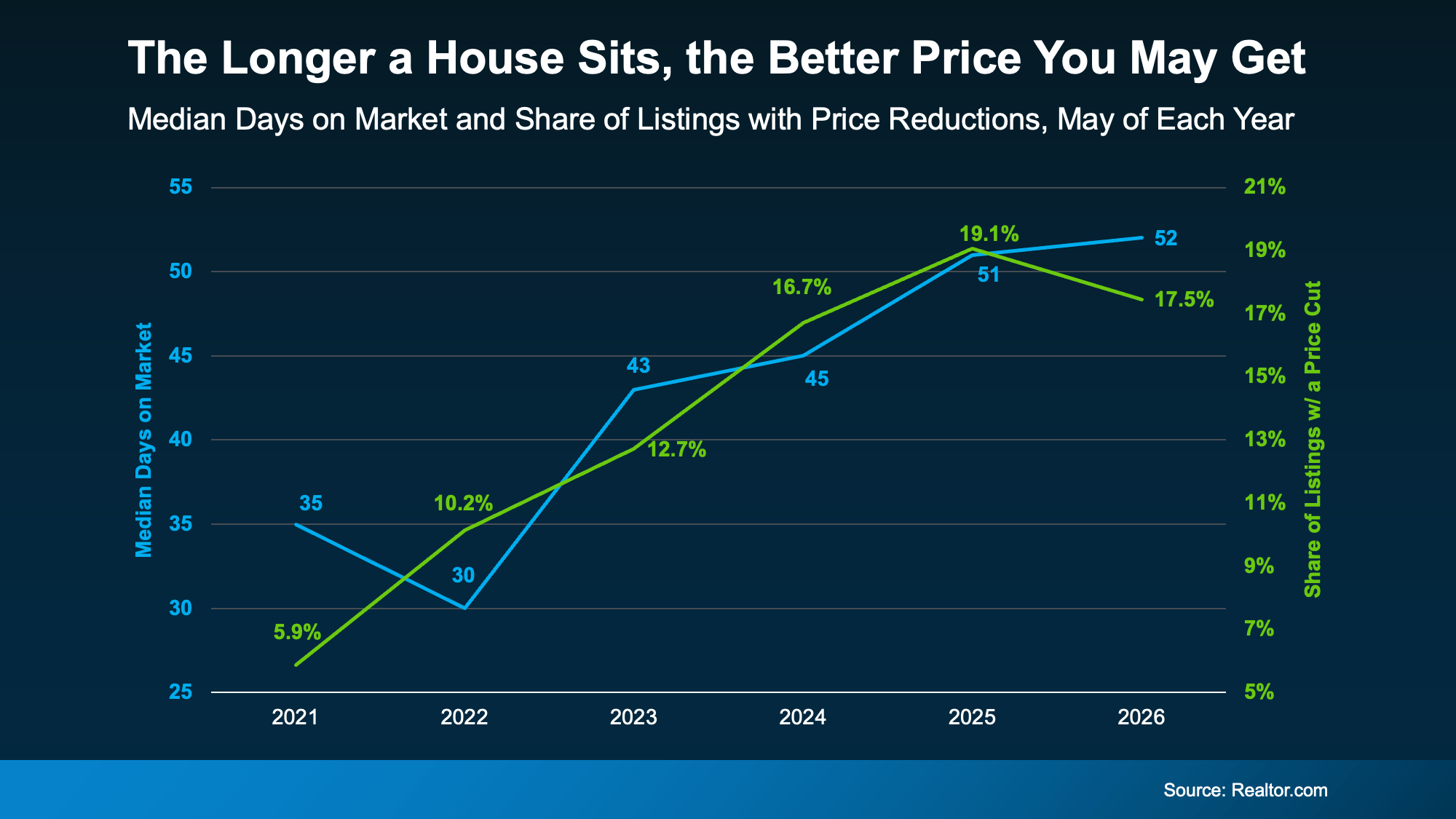
The blue line tracks how long homes stay on the market, while the green line tracks the share of homes getting a price reduction. As one climbs, so does the other.
And if you focus on these homes that are just sitting and waiting, the opportunity for you is bigger than you may think right now.
Redfin data shows there’s $347 billion worth of stale listings on the market right now – more than ever before for this time of year. So, ask your agent to filter listings for you from oldest to newest. The home that fits your budget might already be there. Just further down the list than you thought.
Let’s say you do that and something catches your eye. Still, you might be questioning why the home has been sitting in the first place. Just remember, sometimes it has nothing to do with the home itself.
According to Redfin, common causes are:
The asking price was set too high to start
The home didn’t show well online
There are a lot of homes for sale in the area, so it just got buried
So, nothing that’s necessarily a dealbreaker, or even anything that’s wrong with the home itself. If there’s a real issue, a thorough inspection will surface it. And that’s information you can use to negotiate. Not a reason to assume it’s a house worth skipping over.
So how do you capitalize on a lingering listing? According to USA Today, you have two main levers to pull.
The first is price. Work with your agent to study what comparable homes recently sold for, then build an offer around that. Coming in below asking price is fair game when a home has been sitting.
The second is concessions. If a seller won’t budge much on price, they may still help in other ways, like covering some closing costs, repair credits, or even a mortgage rate buydown that lowers your monthly payment.
A local agent has the context to tell which homes are the real opportunities and which are skippable.
A house sitting on the market isn’t always a glaring red flag. In today’s market, it may be your best opportunity yet.
For help deciding which lingering listings are actually worth a second look, let’s connect.
The information contained, and the opinions expressed, in this article are not intended to be construed as investment advice. Keeping Current Matters, Inc. does not guarantee or warrant the accuracy or completeness of the information or opinions contained herein. Nothing herein should be construed as investment advice. You should always conduct your own research and due diligence and obtain professional advice before making any investment decision. Keeping Current Matters, Inc. will not be liable for any loss or damage caused by your reliance on the information or opinions contained herein.
|
Some Highlights
|
Planning To Retire? Your Equity Can Help You Reach Your Goal.

Whether you've just retired or you're thinking about retirement, you may be considering your options and trying to picture a whole new stage of your life. And you're not alone. Research from the Retirement Industry Trust Association (RITA) shows 10,000 Baby Boomers reach the typical retirement age (65) every day, and only 47% of the people in that generation have already retired.
If this sounds like you, one thing worth considering is whether or not your current home will suit your new lifestyle. If your home doesn't have the features or benefits you're looking for, the good news is, you may be in a better position to move than you realize.
That's because, if you already own a home, you've likely built-up significant equity, and that can help you fuel your next move. According to the National Association of Realtors (NAR):
A homeowner who purchased a typical home five years ago would have gained $125,300 from just price appreciation alone.
In fact, over the last twelve months, CoreLogic reports the average homeowner in the United States gained roughly $64,000 in equity due to home price appreciation.
You can use your equity to help you achieve your homeownership goals. Whether you want to downsize, move closer to loved ones, or buy a home in a dream destination, your equity can help get you there. It may be some (if not all) of what you'd need as your down payment on a home that better fits your changing needs.
To find out how much equity to have in your home, reach out to a trusted real estate professional today.
Bottom Line
Retirement is a big step and so is buying or selling a home. As you move into this new phase of life, let’s connect so you have an expert to guide you through the process as you sell your current home and give you expert advice as you buy one that'll better suit your needs.
|
|
|
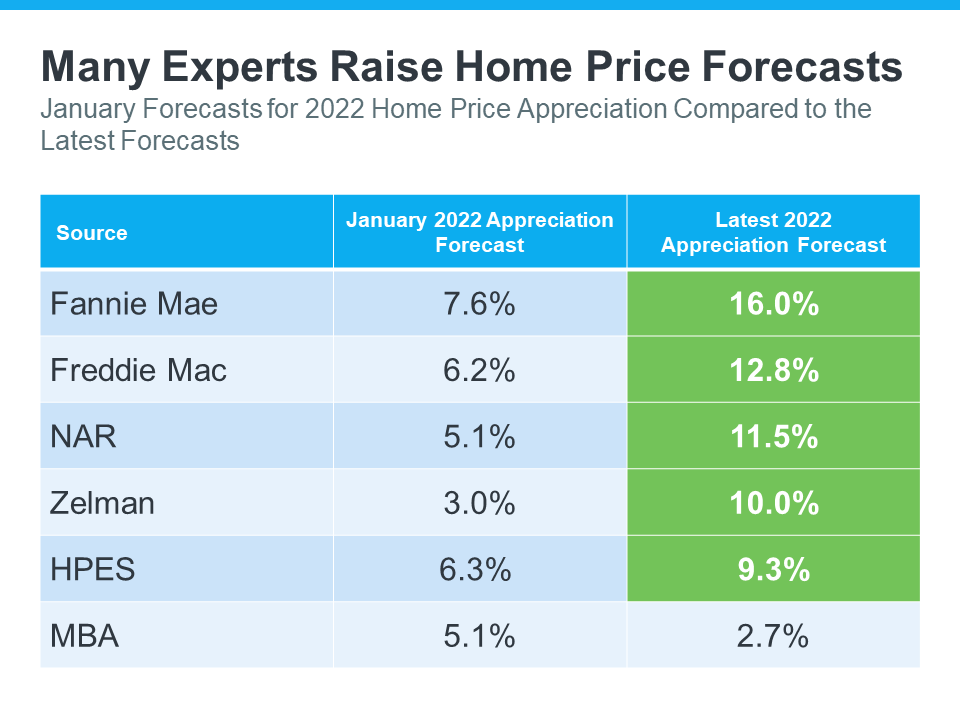
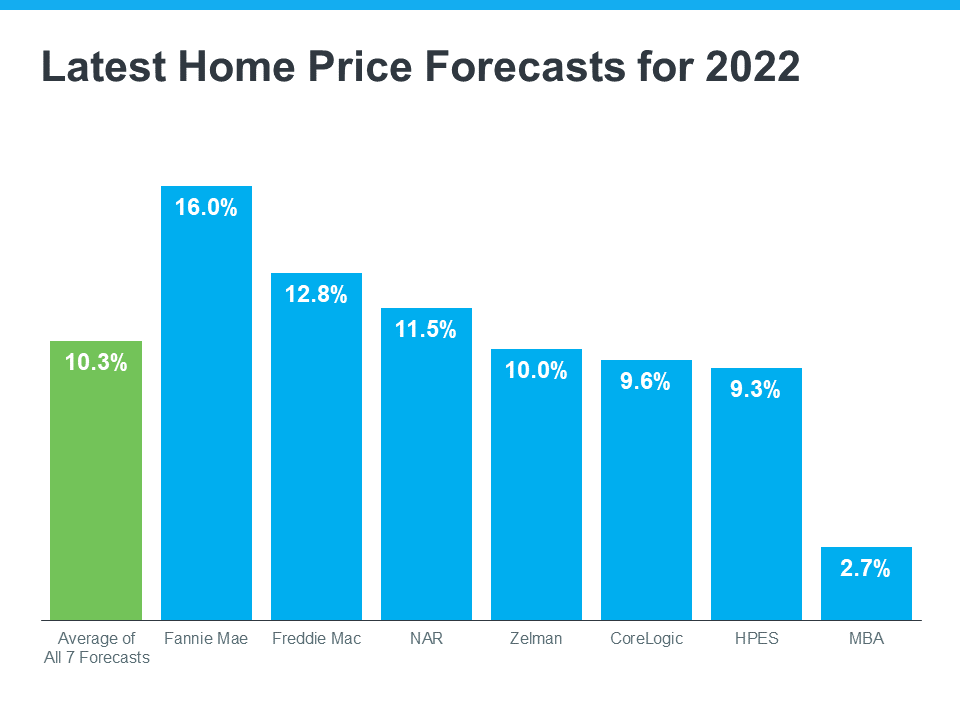
If you're wondering if home prices are going to come down due to the cooldown in the housing market or a potential recession, here's what you need to know. Not only are experts forecasting home prices will continue to appreciate nationwide this year, but most of them also actually increased their projections for home price appreciation from their original 2022 forecasts (shown in green in the chart below):
Knowing that experts forecast home prices will continue to appreciate in most markets and that they've actually increased their original projections for this year should help you answer the question: will home prices fall? According to the latest forecasts, experts are confident prices will continue to appreciate this year, although at a more moderate rate than they did in 2021. Bottom LineIf you're worried home prices are going to decline, rest assured many experts raised their forecasts to say they'll continue to appreciate in most markets this year. If you have questions about what's happening with home prices in our local area, let’s connect.
|
|
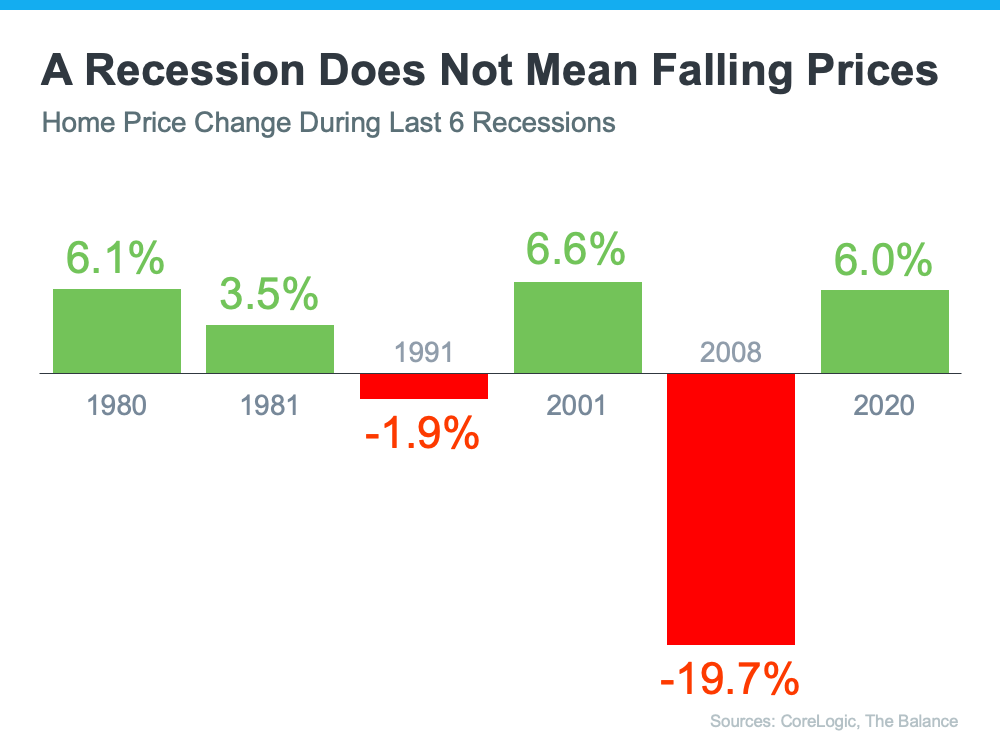
According to a recent survey from the Wall Street Journal, the percentage of economists who believe we'll see a recession in the next 12 months is growing. When surveyed in July 2021, only 12% of economists consulted thought there'd be a recession by now. But this July, when polled, 49% believe we will see a recession in the coming 12 months. And as more recession talk fills the air, one concern many people have is: should I delay my homeownership plans if there's a recession? Here's a look at historical data to show what happened in real estate during previous recessions to help prove why you shouldn't be afraid of what a recession would mean for the housing market today. A Recession Doesn't Mean Falling Home PricesTo show that home prices don't fall every time there's a recession, it helps to turn to historical data. As the graph below illustrates, looking at the recessions going all the way back to 1980, home prices appreciated in four of the last six recessions. So, historically, when the economy slows down, it doesn't mean home values will fall.
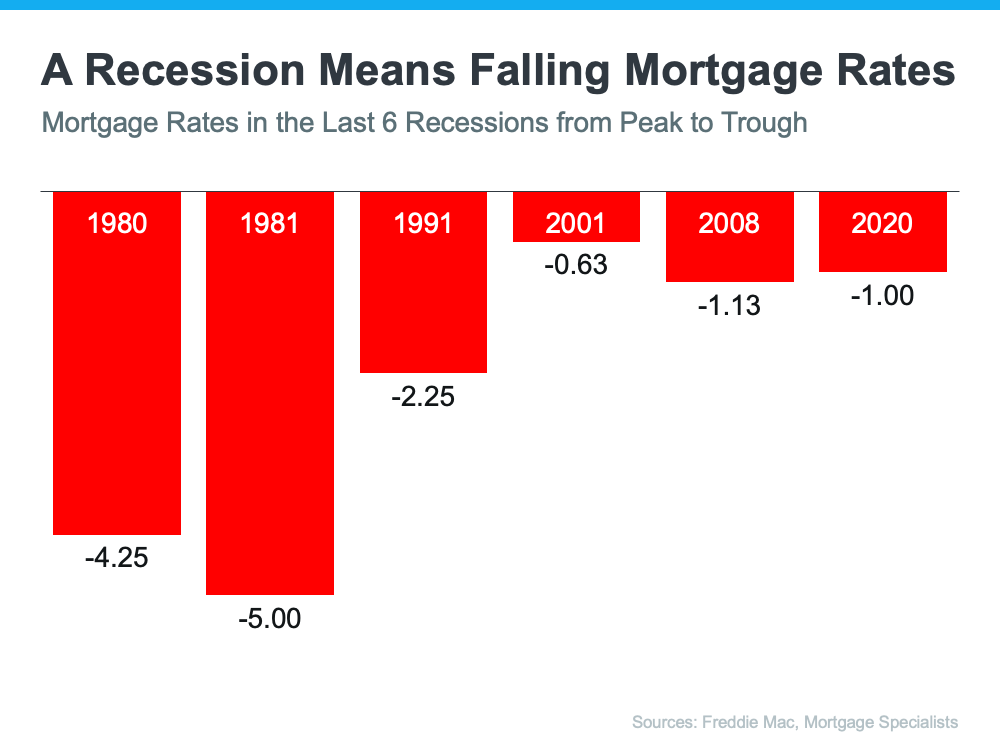
Most people remember the housing crisis in 2008 (the larger of the two red bars in the graph above) and think another recession would repeat what happened then. But this housing market isn't about to crash. The fundamentals are very different today than they were in 2008. So, don't assume we're heading down the same path. A Recession Means Falling Mortgage RatesResearch also helps paint the picture of how a recession could impact the cost of financing a home. As the chart below shows, historically, each time the economy slowed down, mortgage rates decreased.
Fortune explains that mortgage rates typically fall during an economic slowdown:
And while history doesn't always repeat itself, we can learn from and find comfort in the historical data. Bottom LineThere's no doubt everyone remembers what happened in the housing market in 2008. But you don't need to fear the word recession if you're planning to buy or sell a home. According to historical data, in most recessions, home price gains have stayed strong, and mortgage rates have declined. If you're thinking about buying or selling a home, let's connect so you have expert advice on what's happening in the housing market and what that means for your homeownership goals.
|
|
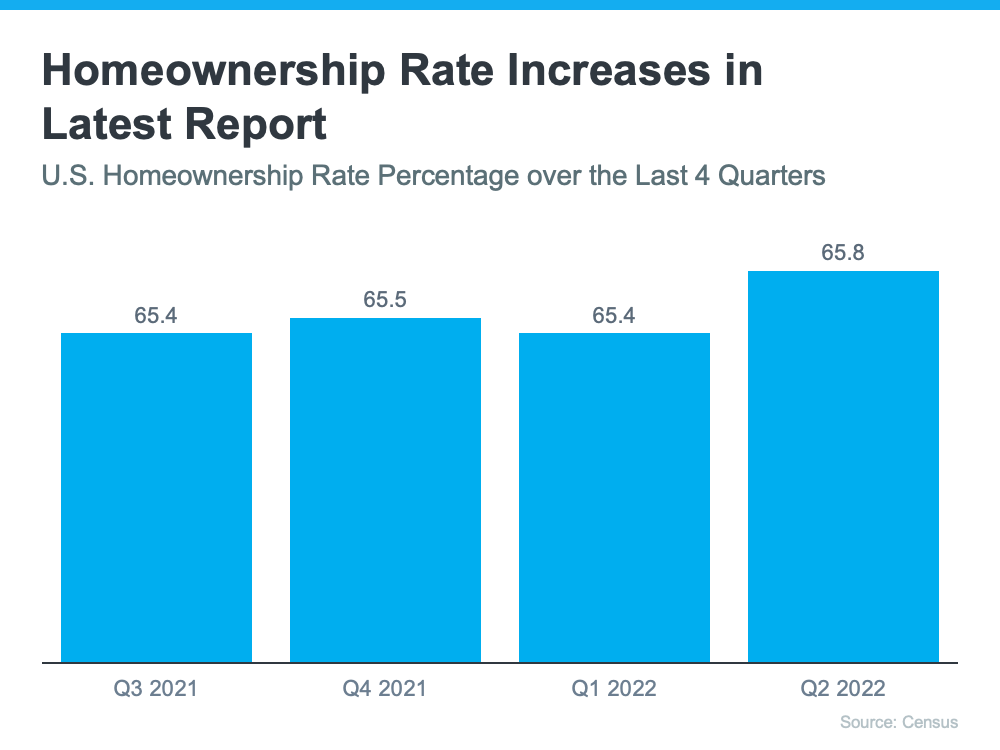
The desire to own a home is still strong today. In fact, according to the Census, the U.S. homeownership rate is on the rise. To illustrate the increase, the graph below shows the homeownership rate over the last year:
That data shows more than half of the U.S. population live in a home they own, and the percentage is growing with time. If you're thinking about buying a home this year, here are just a few reasons why so many people see the value of homeownership. Why Are More People Becoming Homeowners?There are several benefits to owning your home. A significant one, especially when inflation is high like it is today, is that homeownership can help protect you from rising costs. Lawrence Yun, Chief Economist at the National Association of Realtors (NAR), explains:
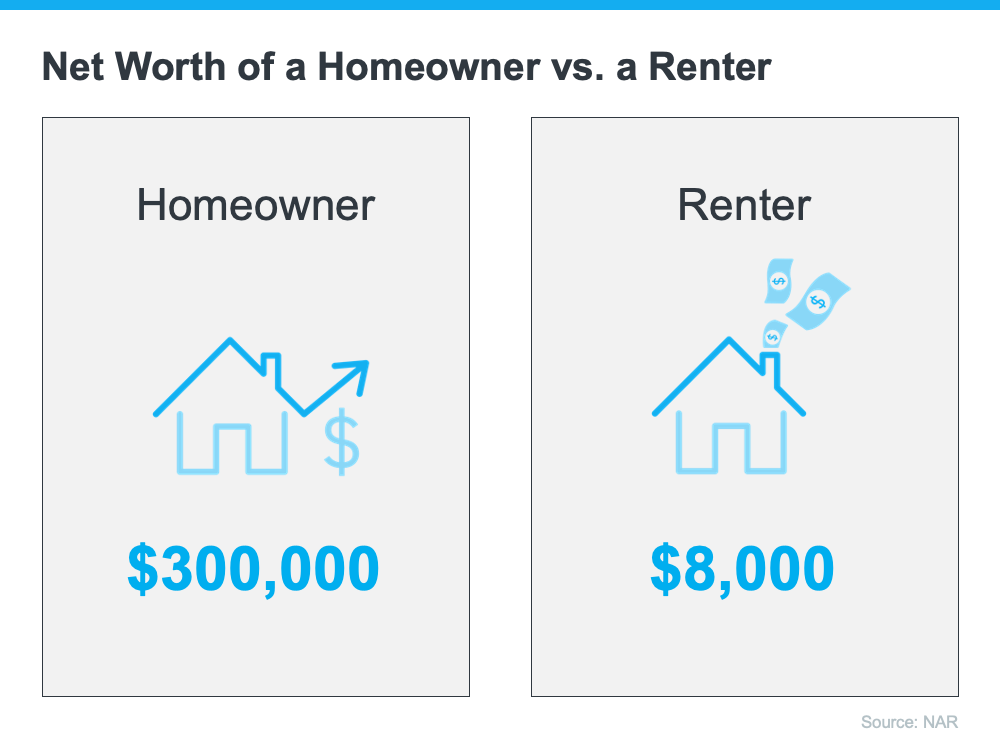
When you buy a home with a fixed-rate mortgage, you can lock in what’s likely your biggest monthly expense – your housing payment – for the duration of that loan, often 15-30 years. That gives you a predictable monthly housing expense that can benefit you in the short term, but you'll also gain equity over time as your home appreciates in value and you make your monthly mortgage payment. And with that growing equity, your net worth will increase as well. In fact, the latest data from NAR shows the median household net worth of a homeowner is roughly $300,000, while the median net worth of renters is only about $8,000. That means a homeowner's net worth is nearly 40 times that of a renter.
Bottom LineThe U.S. homeownership rate is growing. If you're ready to purchase the home of your dreams, let's connect so you can begin the homebuying process today. |
Why Experts Say the Housing Market Won't Crash [INFOGRAPHIC]
![Why Experts Say the Housing
Market Won't Crash [INFOGRAPHIC] | MyKCM](https://ecp.yusercontent.com/mail?url=https%3A%2F%2Ffiles.mykcm.com%2F2022%2F08%2F10115546%2F20220811-MEM-328x600.png&t=1660315377&ymreqid=fa91d6a0-6d01-c85b-1cbd-730001012600&sig=_vPyiigBog4KVogknmpFXw--~D)
Some Highlights
- Many people remember the housing crash in 2008, but experts say today's market is fundamentally different in many ways.
- First, there isn't an oversupply of homes for sale today. Plus, lending standards are much tighter, and homeowners have record levels of equity. That means signs say there won't be a wave of foreclosures like the last time.
- If you have questions about the housing market, let's connect.
|
Whether you're a potential homebuyer, seller, or both, you probably want to know: will home prices fall this year? Let's break down what's happening with home prices, where experts say they're headed, and why this matters for your homeownership goals. Last Year's Rapid Home Price Growth Wasn't the NormIn 2021, home prices appreciated quickly. One reason why is that record-low mortgage rates motivated more buyers to enter the market. As a result, there were more people looking to make a purchase than there were homes available for sale. That led to competitive bidding wars which drove prices up. CoreLogic helps explain how unusual last year's appreciation was:
In other words, the pace of appreciation in 2021 far surpassed the 6% the market saw in 2020. And even that appreciation was greater than the pre-pandemic norm which was typically around 3.8%. This goes to show, 2021 was an anomaly in the housing market spurred by more buyers than homes for sale. Home Price Appreciation Moderates TodayThis year, home price appreciation is slowing (or decelerating) from the feverish pace the market saw over the past two years. According to the latest forecasts, experts say on average, nationwide, prices will still appreciate by roughly 10% in 2022 (see graph below):
Why do all of these experts agree prices will continue to rise? It's simple. Even though housing supply is growing today, it's still low overall thanks to several factors, including a long period of underbuilding homes. And experts say that's going to help keep upward pressure on home prices this year. Additionally, since mortgage rates are higher this year than they were last year, buyer demand has slowed. As the market undergoes this change, it's true price appreciation this year won't match the feverish pace in 2021. But the rapid appreciation the market saw last year wasn't sustainable anyway. What Does That Mean for You?Today, the market is beginning to move back toward pre-pandemic levels. But even the forecast for 10% home price growth in 2022 is well beyond the 3.8% that's more typical for a normal market. So, despite what you may have heard, experts say home prices won't fall in most markets. They'll just appreciate more moderately. If you're worried the house you're trying to sell or the home you want to buy will decrease in value, you should know experts aren't calling for depreciation in most markets, just deceleration. That means your home should still grow in value, just not as fast as it did last year. Bottom LineIf you're thinking of making a move, you shouldn't wait for prices to fall. Experts say nationally, prices will continue to appreciate this year, just at a more moderate pace. When you're ready to begin the process of buying or selling, let's connect so you have a local market expert on your side each step of the way.
|
|
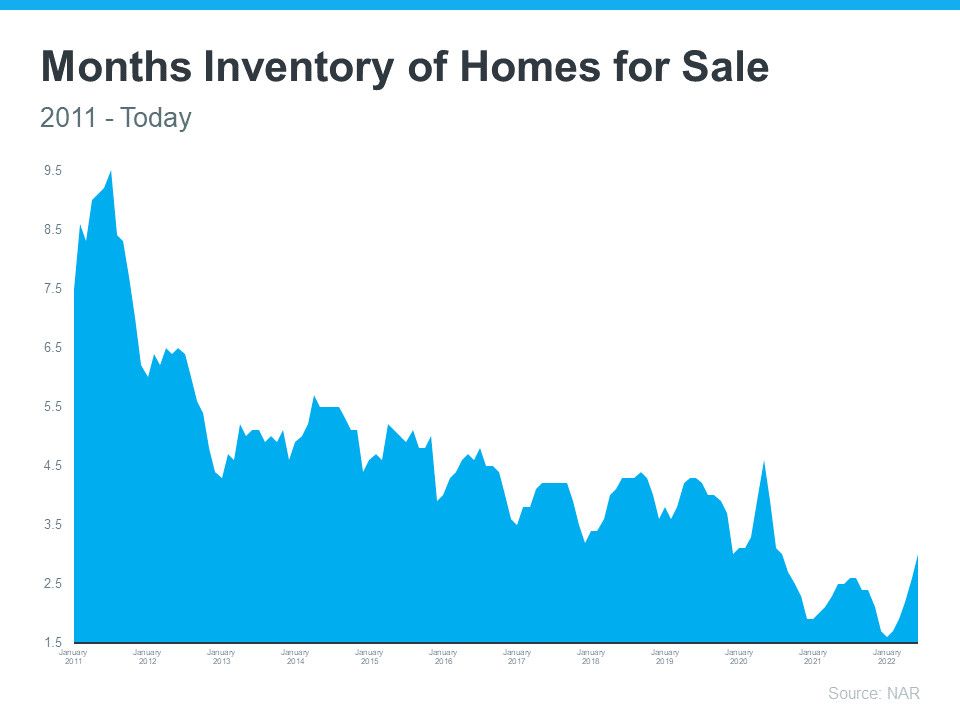
If you tried to buy a home during the pandemic, you know the limited supply of homes for sale was a considerable challenge. It created intense bidding wars which drove home prices up as buyers competed with one another to be the winning offer. But what was once your greatest challenge may now be your greatest opportunity. Today, data shows buyer demand is moderating in the wake of higher mortgage rates. Here are a few reasons why this shift in the housing market is good news for your homebuying plans. The ChallengeThere were many reasons for the limited number of homes on the market during the pandemic, including a history of underbuilding new homes since the market crash in 2008. As the graph below shows, housing supply is well below what the market has seen for most of the past 10 years (see graph below):
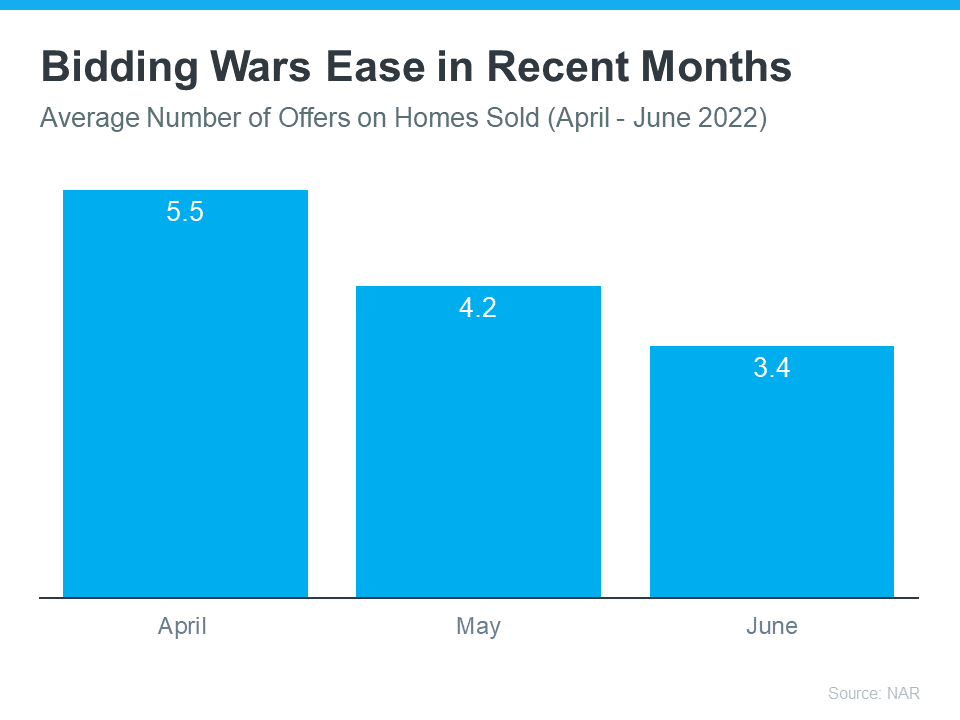
The OpportunityBut that graph also shows a trend back up in the right direction this year. That's because moderating demand is slowing the pace of home sales and that's one of the reasons housing supply is finally able to grow. For you, that means you'll have more options to choose from, so it shouldn't be as difficult to find your next home as it has been recently. And having more options may also lead to less intense bidding wars. Data from the Realtors Confidence Index from the National Association of Realtors (NAR) shows this trend has already begun. In their recent reports, bidding wars are easing month-over-month (see graph below):
If you've been outbid before or you've struggled to find a home that meets your needs, breathe a welcome sigh of relief. The big takeaway here is you have more options and less competition today. Just remember, while easing, data shows multiple-offer scenarios are still happening – they're just not as intense as they were over the past year. You should still lean on an agent to guide you through the process and help you make your strongest offer up front. Bottom LineIf you're still looking to make a move, it may be time to pick your home search back up today. Let's connect to kick off the homebuying process.
|
|
There's no doubt about the fact that the housing market is slowing from the frenzy we saw over the past two years. But what does that mean for you if you're thinking of selling your house? While home prices are still appreciating in most markets and experts say that will continue, they're climbing at a slower pace because rising mortgage rates are creating less buyer demand. Because of this, there are more homes on the market. And in a shift like this one, the way you price your home matters more than ever. Why Today's Housing Market Is DifferentDuring the pandemic, sellers could price their homes higher because demand was so high, and supply was so low. This year, things are shifting, and that means your approach to pricing your house needs to shift too. Because we're seeing less buyer demand, sellers have to recognize this is a different market than it was during the pandemic. Here's what's at stake if you don't. Why Pricing Your House at Market Value MattersThe price you set for your house sends a message to potential buyers. If you price it too high, you run the risk of deterring buyers. When that happens, you may have to lower the price to try to reignite interest in your house when it sits on the market for a while. But be aware that a price drop can be seen as a red flag for some buyers who will wonder what that means about the home or if in fact it's still overpriced. Some sellers aren't adjusting their expectations to today's market, and realtor.com explains the impact that's having:
To avoid the headache of having to lower your price, you'll want to price it right from the onset. A real estate advisor knows how to determine that perfect asking price. To find the right price, they balance the value of homes in your neighborhood, current market trends and buyer demand, the condition of your house, and more. Not to mention, pricing your house fairly based on market conditions increases the chance you'll have more buyers who are interested in purchasing it. This helps lead to stronger offers and a greater likelihood it'll sell quickly. Why You Still Have an Opportunity When You Sell TodayRest assured, it's still a sellers' market, and you'll still get great benefits if you plan accordingly and work with an agent to set your price at the current market value. As Lawrence Yun, Chief Economist at the National Association of Realtors (NAR), says:
Mike Simonsen, the Founder and CEO of Altos Research, also notes:
Bottom LineHome priced right are selling quickly in today's real estate market. Let’s connect to make sure you price your house based on current market conditions so you can maximize your sales potential and minimize your hassle in a shifting market. |
Housing Market Forecast for the Rest of 2022 [INFOGRAPHIC]
![Housing Market Forecast for
the Rest of 2022 [INFOGRAPHIC] | MyKCM](https://ecp.yusercontent.com/mail?url=https%3A%2F%2Ffiles.mykcm.com%2F2022%2F08%2F04103940%2F20220805-MEM-324x600.png&t=1659710488&ymreqid=fa91d6a0-6d01-c85b-1cef-50000101f000&sig=qBUpu7YAppRpOV4pjN8F4g--~D)
Some Highlights
- The housing market is shifting away from the intensity of the past two years. Here's what experts project for the remainder of 2022.
- Home prices are forecast to rise more moderately than last year. Mortgage rates will respond to inflation, and home sales will be more in line with pre-pandemic years.
- Let's connect so you can make your best move this year.
![Why a Home Inspection Is
Important [INFOGRAPHIC] | MyKCM](https://ecp.yusercontent.com/mail?url=https%3A%2F%2Ffiles.mykcm.com%2F2022%2F08%2F18110253%2F20220819-MEM-321x600.png&t=1660918967&ymreqid=fa91d6a0-6d01-c85b-1c01-710026010c00&sig=6taf9RjOIqo_7wp5SA5DKg--~D)