That House That’s Been Sitting Could Be Your Best Shot at a Deal

BLOGJune 22, 2026


Open up a home search and you'll see them. Listings that have been on the market for two months. Three. Some longer.

Most buyers scroll right past them, assuming something’s wrong with the house. But that instinct could be costing you, since the longer a home sits, the more motivated the seller usually gets.

Where Some Buyers Are Finding Better Deals

If affordability has been your #1 hurdle to buying, here’s a surprisingly simple strategy that could help you finally get your foot in the door. Start with the homes that have been sitting the longest. That’s often where the best deals are.

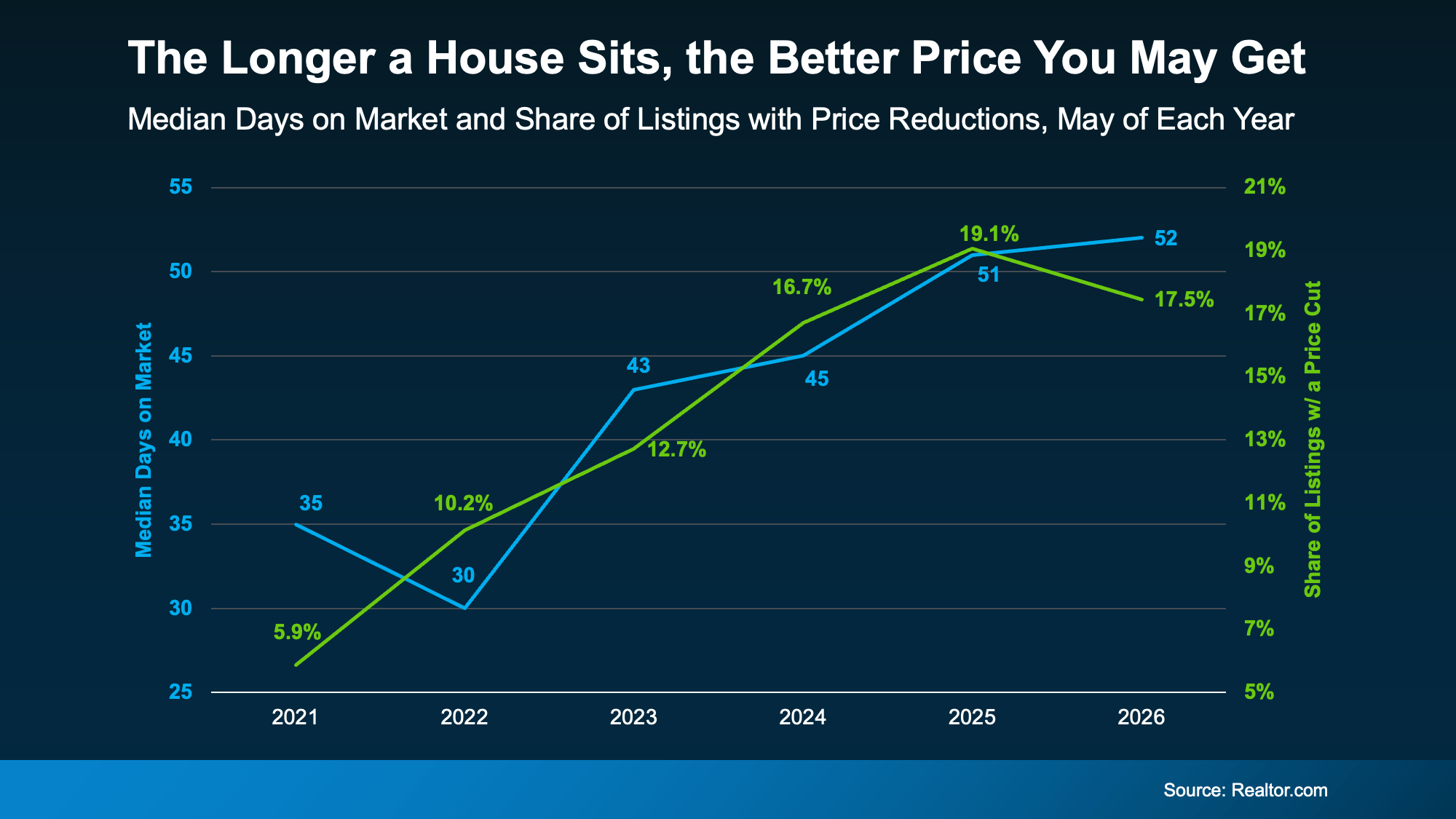
Here’s why. Data from Realtor.com shows there’s a connection between longer time on the market and lower sales prices. Basically, the longer a house sits, the more likely it is that the seller will reduce the price (see graph below):

a graph with numbers and lines

The blue line tracks how long homes stay on the market, while the green line tracks the share of homes getting a price reduction. As one climbs, so does the other.  

And if you focus on these homes that are just sitting and waiting, the opportunity for you is bigger than you may think right now.

Redfin data shows there’s $347 billion worth of stale listings on the market right now – more than ever before for this time of year. So, ask your agent to filter listings for you from oldest to newest. The home that fits your budget might already be there. Just further down the list than you thought.

Lingering Doesn’t Always Mean Something’s Wrong 

Let’s say you do that and something catches your eye. Still, you might be questioning why the home has been sitting in the first place. Just remember, sometimes it has nothing to do with the home itself.

According to Redfin, common causes are:

  • The asking price was set too high to start

  • The home didn’t show well online

  • There are a lot of homes for sale in the area, so it just got buried

So, nothing that’s necessarily a dealbreaker, or even anything that’s wrong with the home itself. If there’s a real issue, a thorough inspection will surface it. And that’s information you can use to negotiate. Not a reason to assume it’s a house worth skipping over.

How To Turn a Lingering Listing into a Win

So how do you capitalize on a lingering listing? According to USA Today, you have two main levers to pull.

The first is price. Work with your agent to study what comparable homes recently sold for, then build an offer around that. Coming in below asking price is fair game when a home has been sitting.

The second is concessions. If a seller won’t budge much on price, they may still help in other ways, like covering some closing costs, repair credits, or even a mortgage rate buydown that lowers your monthly payment.

A local agent has the context to tell which homes are the real opportunities and which are skippable.

Bottom Line

A house sitting on the market isn’t always a glaring red flag. In today’s market, it may be your best opportunity yet.

For help deciding which lingering listings are actually worth a second look, let’s connect.

The information contained, and the opinions expressed, in this article are not intended to be construed as investment advice. Keeping Current Matters, Inc. does not guarantee or warrant the accuracy or completeness of the information or opinions contained herein. Nothing herein should be construed as investment advice. You should always conduct your own research and due diligence and obtain professional advice before making any investment decision. Keeping Current Matters, Inc. will not be liable for any loss or damage caused by your reliance on the information or opinions contained herein.

June 6, 2024

Your Equity Could Make a Move Possible

Your Equity Could Make a Move Possible

BLOGJune 6, 2024


Many homeowners looking to sell feel like they’re stuck between a rock and a hard place right now. Today’s mortgage rates are higher than the one they currently have on their home, and that’s making it harder to want to sell and make a move. Maybe you’re in the same boat.

But what if there was a way to offset these higher borrowing costs? There is. And the money you need probably already exists in your current home in the form of equity.

What Is Equity?

Think of equity as a simple math equation. Freddie Mac explains:

“. . . your home’s equity is the difference between how much your home is worth and how much you owe on your mortgage.”

Your equity grows as you pay down your loan over time and as home prices climb. And thanks to the rapid home price appreciation we saw in recent years, you probably have a whole lot more of it than you realize.

The latest from the Census and ATTOM shows more than two out of three homeowners have either completely paid off their mortgages (shown in green in the chart below) or have at least 50% equity (shown in blue in the chart below):
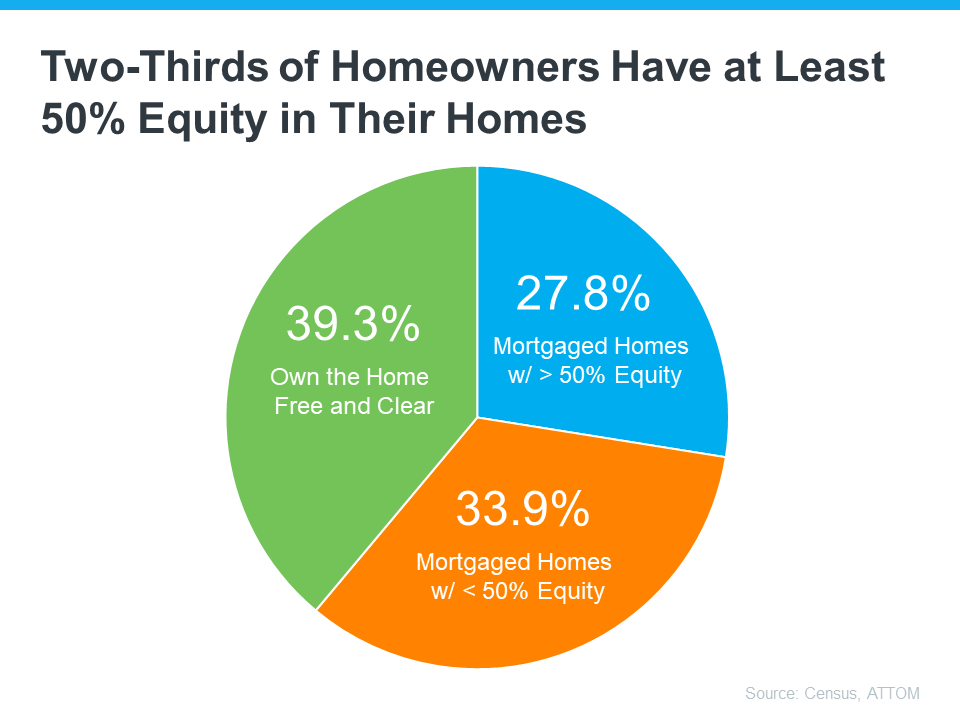
 

That means the majority of homeowners have a game-changing amount of equity right now.

How Your Equity Can Help Fuel Your Move

After you sell your house, that equity can help you move without worrying as much about today’s mortgage rates. As Danielle Hale, Chief Economist for Realtor.com says:

“A consideration today's homeowners should review is what their home equity picture looks like. With the typical home listing price up 40% from just five years ago, many home sellers are sitting on a healthy equity cushion. This means they are likely to walk away from a home sale with proceeds that they can use to offset the amount of borrowing needed for their next home purchase.”

To give you some examples, here are a few ways you can use equity to buy your next home:

  • Be an all-cash buyer: If you’ve been living in your current home for a long time, you might have enough equity to buy your next home without having to take out a loan. If that’s the case, you won’t need to borrow any money or worry about mortgage rates. 
  • Make a larger down payment: Your equity could also be used toward your next down payment. It might even be enough to let you put a larger amount down, so you won’t have to borrow as much at today’s rates. 

The First Step: Determine How Much Equity You Have in Your Home

Want to find out how much equity you have? To do that, you’ll need two things:

  1. The current mortgage balance on your home
  2. The current value of your home

You can probably find the mortgage balance on your monthly mortgage statement. To understand the current market value of your house, you can pay hundreds of dollars for an appraisal, or you can contact a local real estate agent who will be able to present to you, at no charge, a professional equity assessment report (PEAR).

Once you’ve connected with a trusted local agent and run the numbers, you’re one step closer to making a move you may not have thought was realistic – all thanks to your equity.

Bottom Line

If you want to find out how much equity you have and talk more about how it can make your next move possible, let’s connect.


Posted in Market Updates
June 4, 2024

What To Expect if You Buy or Sell a Home This June

What To Expect if You Buy or Sell a Home This June

BLOGJune 4, 2024


June is a busy month in the housing market because a lot of people buy and sell this time of year. So, if you’ve got a move on your mind and you’re looking to make it happen this month, here’s a snapshot of what you need to know to make sure you’re ready.

If You’re Buying This June

A lot of homebuyers with children like to move after one school year ends and before the next one begins. That’s one reason why late spring into summer is a popular time for homes to change hands. And whether that’s a motivator for you or not, it’s important to realize more buyers are going to be looking right now – and that means you’ll want to be ready for a bit more competition. But there is a silver lining to a move this time of year. This is also when more sellers will list – so you should find you have more options. As an article from Bankrate says:

Late spring and early summer are the busiest and most competitive time of year for the real estate market. There’s usually more inventory listed for sale than other times of year . . . This is a double-edged sword for a buyer, as you will be met with more opportunities but [also] much more competition.”

During this busy season, it’s extra important to work with a trusted real estate agent. Your agent will help you stay on top of the latest listings, share expertise on how to make a strong offer in a competitive market, and give you insight into things like what the home is actually worth so you can make an informed decision when you buy. As Forbes says:

Approaching the market confidently, armed with good information and grounded expectations will take you far. Don't let the hustle of the market convince you to buy something that’s not in your budget, or not right for your lifestyle.”

If You’re Selling This June

Because there are more buyers this time of year, you’re in a great spot as a seller. Many of those buyers are highly motivated to make their move happen before the next school year kicks off – so they’ll likely put in strong offers to try to make that possible. That means, if your house shows well and is listed at market value, you could see your house sell faster or for a higher price. According to the National Association of Realtors (NAR):

“Warmer weather and the end of the school year encourage more people to buy and sell, respectively. Buyers are looking to move and settle before the new school year begins, contributing to increased competition and, consequently, higher prices.”

You want to be sure you’ve got a great agent on your side to help you with the contingencies on those offers and any negotiations that take place so you can pick the best offer. Make sure you go over closing dates with your agent. Buyers trying to time their move with the school year may need to delay a bit or move faster. This can depend on the school calendar where you live. As U.S. News Real Estate explains:

“ . . if your house goes under contract in early summer, the buyer may ask for a delay in closing or move-in until the school year finishes or their current home has sold. Alternatively, a buyer later in summer may be looking to close quickly and move in under a month. Remain flexible to keep the deal running smoothly, and your buyer may be willing to throw in concessions, like covering some of your closing costs or overlooking the old roof.”

Bottom Line

If you’re looking to make a move this June, let’s chat so you know what to expect. We’ll come up with a plan that factors in current market conditions, but still works for you.

Posted in Market Updates
June 4, 2024

What To Expect if You Buy or Sell a Home This June

What To Expect if You Buy or Sell a Home This June

BLOGJune 4, 2024


June is a busy month in the housing market because a lot of people buy and sell this time of year. So, if you’ve got a move on your mind and you’re looking to make it happen this month, here’s a snapshot of what you need to know to make sure you’re ready.

If You’re Buying This June

A lot of homebuyers with children like to move after one school year ends and before the next one begins. That’s one reason why late spring into summer is a popular time for homes to change hands. And whether that’s a motivator for you or not, it’s important to realize more buyers are going to be looking right now – and that means you’ll want to be ready for a bit more competition. But there is a silver lining to a move this time of year. This is also when more sellers will list – so you should find you have more options. As an article from Bankrate says:

Late spring and early summer are the busiest and most competitive time of year for the real estate market. There’s usually more inventory listed for sale than other times of year . . . This is a double-edged sword for a buyer, as you will be met with more opportunities but [also] much more competition.”

During this busy season, it’s extra important to work with a trusted real estate agent. Your agent will help you stay on top of the latest listings, share expertise on how to make a strong offer in a competitive market, and give you insight into things like what the home is actually worth so you can make an informed decision when you buy. As Forbes says:

Approaching the market confidently, armed with good information and grounded expectations will take you far. Don't let the hustle of the market convince you to buy something that’s not in your budget, or not right for your lifestyle.”

If You’re Selling This June

Because there are more buyers this time of year, you’re in a great spot as a seller. Many of those buyers are highly motivated to make their move happen before the next school year kicks off – so they’ll likely put in strong offers to try to make that possible. That means, if your house shows well and is listed at market value, you could see your house sell faster or for a higher price. According to the National Association of Realtors (NAR):

“Warmer weather and the end of the school year encourage more people to buy and sell, respectively. Buyers are looking to move and settle before the new school year begins, contributing to increased competition and, consequently, higher prices.”

You want to be sure you’ve got a great agent on your side to help you with the contingencies on those offers and any negotiations that take place so you can pick the best offer. Make sure you go over closing dates with your agent. Buyers trying to time their move with the school year may need to delay a bit or move faster. This can depend on the school calendar where you live. As U.S. News Real Estate explains:

“ . . if your house goes under contract in early summer, the buyer may ask for a delay in closing or move-in until the school year finishes or their current home has sold. Alternatively, a buyer later in summer may be looking to close quickly and move in under a month. Remain flexible to keep the deal running smoothly, and your buyer may be willing to throw in concessions, like covering some of your closing costs or overlooking the old roof.”

Bottom Line

If you’re looking to make a move this June, let’s chat so you know what to expect. We’ll come up with a plan that factors in current market conditions, but still works for you.

Posted in Market Updates
June 3, 2024

More Than a House: The Emotional Benefits of Homeownership

More Than a House: The Emotional Benefits of Homeownership

BLOGJune 3, 2024

With all the headlines and talk about housing affordability, it can be tempting to get lost in the financial side of buying a home. That’s only natural as you think about the dollars and cents of it all.

And while you ultimately need to be able to afford a home you buy, don’t lose sight of why homeownership was so important to you in the first place. That’s because buying a home is so much more than just a financial transaction. As the National Association of Realtors (NAR) says:

“The benefits of purchasing and owning your place of residence are both financial and emotional – pride in homeownership and the feeling of security are huge intangible benefits.”

Here’s a look at just a few of those more emotional or lifestyle perks, to help anchor you to why homeownership is one of your goals.

A Sense of Satisfaction

Owning a home is often associated with better mental health and well-being. That’s probably because buying a home is a big milestone. And the sense of satisfaction and pride that comes with achieving that goal just feels good. A recent article from the Mortgage Reports says:

“By and large, homeownership brings more satisfaction than renting. . . Surveyees scored the overall happiness level of homeowners at 88% compared to 67% for renters.”

More Stability for Your Family

Another thing that may make homeowners feel more satisfied is that they’re finally able to put down roots. Think about it. If you’re used to moving each time your lease renews and your rent climbs, staying put for a while would be nice not just for you, but for any loved ones that live with you.

A home can provide more predictability and the chance to make long-term friends. That should reduce everyone’s stress too. As NAR explains:

“Families also benefit from homeownership, with studies proving that parents are able to spend less time in a stressed state, therefore spending more time with their children. The ability for parents to feel stable has a huge impact on children’s behavioral issues, educational success, and future economic success.”

A Stronger Feeling of Community

And if you’re also looking for a sense of belonging for yourself, homeownership can help with that too. As FinHabits says:

“Homeowners tend to be more involved in their local communities, leading to a stronger sense of belonging . . .”

It makes sense. Your home connects you to your neighborhood and, by extension, your broader community. That’s because owning a home gives you a stake in that community’s future. So, becoming more involved and wanting to do what you can to help improve the area while making long-term relationships with neighbors is only natural.

The Ability To Make the Space Your Own

And don’t forget, your home is a place that’s all yours. Unless you’ve got specific homeowner’s association requirements, you’re free to customize it however you see fit.

So, if renting has been cramping your style, it’s time to express yourself and jump on the latest trends (if you want to). Whether that’s small home improvements or full-on renovations, your house can be exactly what you want and need it to be. And as your tastes and lifestyle change, so can your home. Picture coming home each day to a place that feels like you. That’s a feeling like no other. 

Bottom Line

If you want to enjoy a sense of accomplishment and pride in where you’re living, let’s have a conversation to go over what you need to do now to make this future happen for you.

Posted in Market Updates
May 30, 2024

The Biggest Mistakes Buyers Are Making Today

The Biggest Mistakes Buyers Are Making Today

BLOGMay 30, 2024


Buyers face challenges in any market – and today’s is no different. With higher mortgage rates and rising prices, plus the limited supply of homes for sale, there’s a lot to consider.

But, there's one way to avoid getting tripped up – and that’s leaning on a real estate agent for the best possible advice. An expert’s insights will help you avoid some of the most common mistakes homebuyers are making right now.

Putting Off Pre-approval

As part of the homebuying process, a lender will look at your finances to figure out what they’re willing to loan you for your mortgage. This gives you a good idea of what you can borrow so you can really wrap your head around the financial side of things before you start looking at homes. While house hunting can be a lot more fun than talking about finances, you don’t want to do this out of order. Make sure you get your pre-approval first. As CNET explains:

“If you wait to get preapproved until the last minute, you might be scrambling to contact a lender and miss the opportunity to put a bid on a home.”

Holding Out for Perfection

While you may have a long list of must-haves and nice-to-haves, you need to be realistic about your home search. Even though your ideal state is you find a home that checks every box, you may need to be willing to compromise – especially since inventory is still low. Plus, a home that has everything you want may be too pricey. As Investopedia puts it:

When you expect to find the perfect home, you could prolong the homebuying process by holding out for something better. Or you could end up paying more for a home just because it meets all your needs.”

Instead, look for something that has most of your must-haves and good bones where you can add anything else you may need down the line.

Buying More House Than You Can Afford

With today’s mortgage rates and home prices, there’s no arguing it’s expensive to buy a home. And while it may be tempting to stretch your finances a bit further than you’re comfortable with to make sure you get the house, you want to avoid overextending your budget. Make sure you talk to your agent about how changing mortgage rates impact your monthly payment. Bankrate offers this advice:

“Focus on what monthly payment you can afford rather than fixating on the maximum loan amount you qualify for. Just because you can qualify for a $300,000 loan doesn’t mean you can comfortably handle the monthly payments that come with it along with your other financial obligations. Every borrower’s case is different, so factor in your whole financial profile when determining how much house you can afford.”

Not Working with a Local Real Estate Agent

This last one may be the most important of all. Buying a home is a process that involves a lot of steps, paperwork, negotiation, and more. Rather than take all of this on yourself, it’s a good idea to have a pro working with you. The right agent will reduce your stress and help the process go smoothly. As CNET explains:

Attempting to buy a home without a real estate agent makes the process more arduous than it needs to be. A real estate agent can give you professional legal guidance, market expertise and support, which will save you time, money and stress. They can also increase your chances of finding the right home so you don’t have to spend hours scouring the internet for listings.”  

Bottom Line

Mistakes can cost you time, frustration, and money. If you want to buy a home in today’s market, let’s connect so you have a pro on your side who can help you avoid these missteps.

Posted in Market Updates
May 29, 2024

How an Agent Helps Market Your House

How an Agent Helps Market Your House

BLOGMay 29, 2024


You’re ready to sell your house. But what do you need most from your real estate agent? Well, the National Association of Realtors (NAR) asked that very question to recent sellers and found one of the top things they were looking for is help marketing their house to potential buyers. Maybe that’s what you need the most help with too.

You expect your real estate agent to write a great description of your house for the listing and pair it with some high-quality photos. But that’s not all you’re going to get when you partner with a great agent.

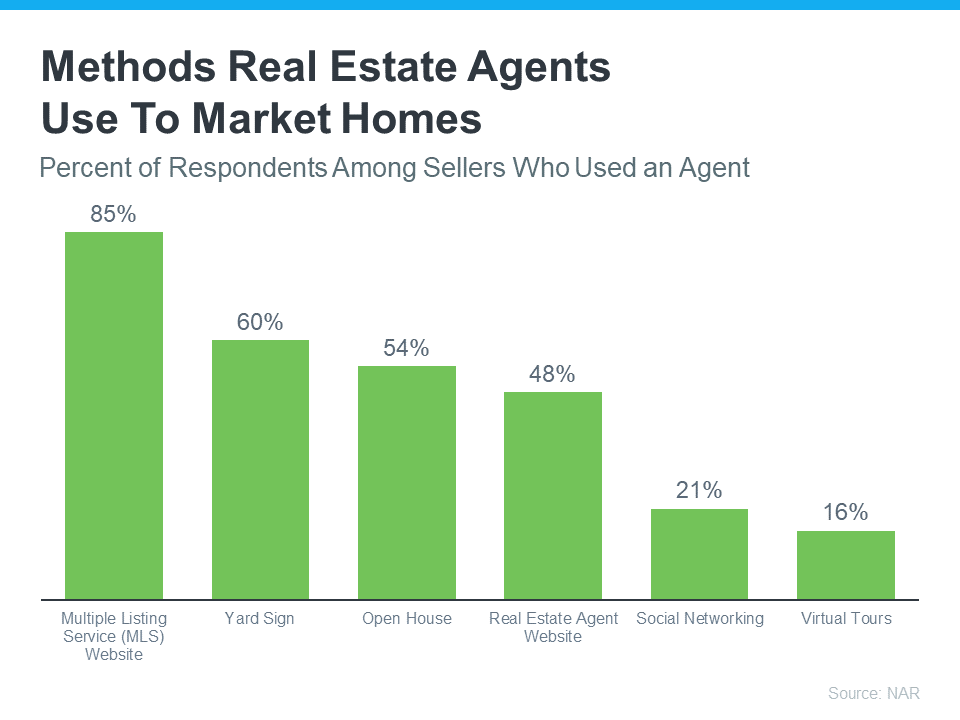
They’ll do a lot more to make sure your house stands out. Here are some of the most common methods real estate agents use to market homes according to that same report from NAR (see graph below):

No Caption Received


So, how can you benefit from your agent using these methods?

  • Listing on the MLS – By listing your house on the MLS, it will get more visibility from other real estate agents and buyers. This could lead to more traffic, which could ultimately help you see an increase in offers and ultimately a better price.
  • Using a Yard Sign – A yard sign catches the eye of people driving or walking by. This method drums up local interest since people who live nearby might have friends or family looking to move into the area. It also prominently displays your agent’s contact information, so interested buyers can get in touch easily.
  • Having an Open House – When your agent advertises and hosts your open house, buyers see others are interested in your house, too. This competition can lead to stronger offers. An open house is also easier for you since you only need to leave once for many buyers to visit. Plus, your agent may get useful feedback on what people like or don’t like, which can help you make improvements to attract more buyers later, if needed.
  • Showcasing on Your Agent’s Website – Having your house visible on your agent’s website allows for a professional presentation of your property. Additionally, people visiting your agent’s website are more likely to be serious buyers who are ready to make a move.
  • Social Networking – Your real estate agent works hard to have a wide-ranging social media presence. Marketing your house this way allows them to reach a large audience. It also makes it easy for people to share your listing with friends and loved ones who might be interested.
  • Providing Virtual Tours – Virtual tours are extremely convenient for buyers, especially those who are relocating from out of town. This method allows them to tour anytime, day or night. It shows your agent is using the latest technology to market your house.

There are many tools that can be used to market your house. As NerdWallet sums up:

A good real estate agent will have a robust plan to promote your listing in an effort to find the right pool of buyers. Adding your home to databases of available homes called multiple listing services (MLS), open houses, 3D virtual tours, professional photography and broker tours for buyers’ agents (particularly for luxury homes) are all factors that may go into a marketing plan.”

As a seller, it’s smart to work with a creative local real estate agent who can maximize them to make sure you get as many eyes on your house as possible.

Bottom Line

When it comes to marketing your house, working with a local real estate agent has tons of benefits. If you’re ready to sell, but don’t know where to start, let’s chat.

Posted in Market Updates
May 24, 2024

Your Agent Is the Key To Pricing Your House Right [INFOGRAPHIC]

Your Agent Is the Key To Pricing Your House Right [INFOGRAPHIC]

INFOGRAPHICMay 24, 2024

No Caption Received

Some Highlights

  • The asking price for your house can impact your bottom line and how quickly it sells.
  • Both under- and overpricing have drawbacks. So to find the right price for your house, lean on your agent for their expertise.
  • Don’t pick just any price for your listing. Trust your real estate professional to help you find the perfect price for your house.
Posted in Market Updates
May 24, 2024

Questions You May Have About Selling Your House

Questions You May Have About Selling Your House

BLOGMay 23, 2024


There’s no denying mortgage rates are having a big impact on today’s housing market. And that may leave you with some questions about whether it still makes sense to sell your house and make a move.

Here are three of the top questions you may be asking – and the data that helps answer them.

1. Should I Wait To Sell?

If you’re thinking about waiting to sell until after mortgage rates come down, here’s what you need to know. So are a ton of other people.

And while mortgage rates are still forecasted to come down later this year, if you wait for that to happen, you may be dealing with a lot more competition as other buyers and sellers jump back in too. As Bright MLS says:

“Even a modest drop in rates will bring both more buyers and more sellers into the market.”

That means if you wait it out, you’ll have to deal with things like prices rising faster and more multiple-offer scenarios when you buy your next home.

2. Are Buyers Still Out There?

But that doesn’t mean no one is moving right now. While some people are holding off, there are still plenty of buyers active today. And here’s the data to prove it.

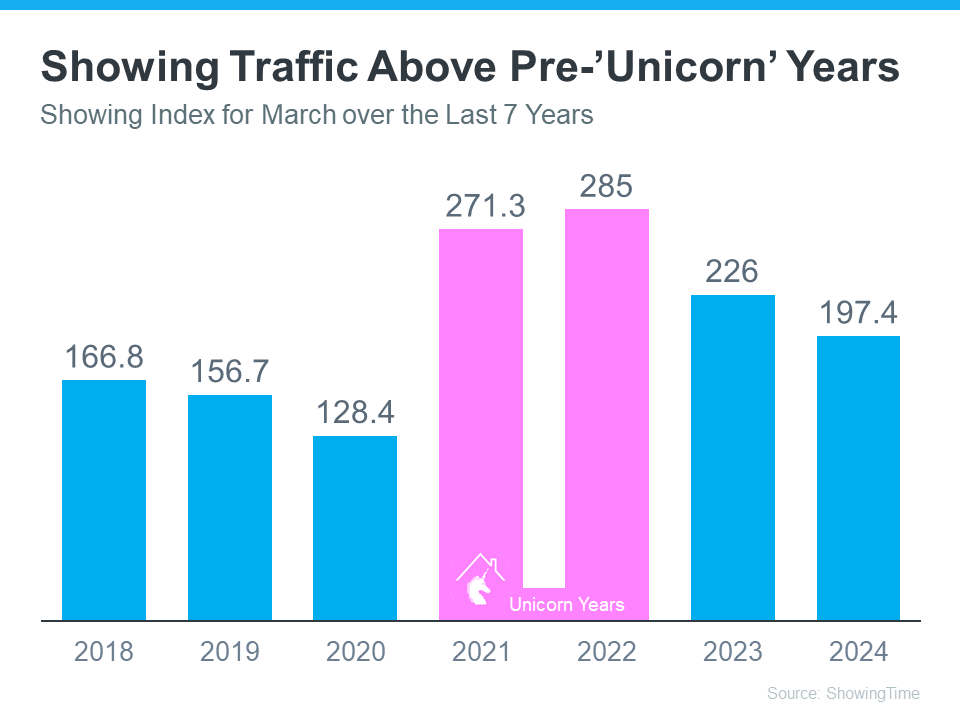
The ShowingTime Showing Index is a measure of how frequently buyers are touring homes. The graph below uses that index to show buyer activity for March (the latest data available) over the past seven years:No Caption Received


You can see demand has dipped some since the ‘unicorn’ years (shown in pink). That’s in response to a lot of market factors, like higher mortgage rates, rising prices, and limited inventory. But, to really understand today’s demand, you have to compare where we are now with the last normal years in the market (2018-2019) – not the abnormal ‘unicorn’ years. 

When you focus on just the blue bars, you can get an idea of how 2024 stacks up. And that gives you a whole new perspective.

Nationally, demand is still high compared to the last normal years in the housing market (2018-2019). And that means there’s still a market for your house to sell.

3. Can I Afford To Buy My Next Home?

And if you’re worried about how you’ll afford your next move with today’s rates and prices, consider this: you probably have more equity in your current home than you realize.

Homeowners have gained record amounts of equity over the past few years. And that equity can make a big difference when you buy your next home. You may even have enough to be an all-cash buyer and avoid taking out a mortgage altogether. As Jessica Lautz, Deputy Chief Economist at the National Association of Realtors (NAR), says:

“ . . . those who have earned housing equity through home price appreciation are the current winners in today's housing market. One-third of recent home buyers did not finance their home purchase last month—the highest share in a decade. For these buyers, interest rates may be less influential in their purchase decisions.”

Bottom Line

If you’ve had these three questions on your mind and they’ve been holding you back from selling, hopefully, it helps to have this information now. A recent survey from Realtor.com shows more than 85% of potential sellers have been considering selling for over a year. That means there are a number of sellers like you who are on the fence.

But that same survey also talked to sellers who recently decided to take the plunge and list. And 79% of those recent sellers wish they’d sold sooner.

If you want to talk more about any of these questions or need more information, let’s connect.

Posted in Market Updates
May 22, 2024

How Many Homes Are Investors Actually Buying?

How Many Homes Are Investors Actually Buying?

BLOGMay 22, 2024


Are big investors really buying up all the homes today?

If you’re trying to find a house to buy, this may be something you’re wondering about. Maybe you’ve read about it or seen reels on social media saying investors buying all the homes is making it even harder to find what the average buyer is looking for. But spoiler alert – there’s a lot of misinformation out there. To clear things up, here's the scoop on what's really happening. A lot of the big investor activity is actually in the rearview mirror already.

The Wall Street Journal (WSJ) explains:

“Investors of all sizes spent billions of dollars buying homes during the pandemic. At the 2022 peak, they bought more than one in every four single-family homes sold, though more recently their activity has slowed as interest rates rose and supply became tighter.”

The key here is investor activity has slowed significantly, and even during the peak of investor buying, 3 out of every 4 single-family homes purchased were by regular, everyday buyers – not investors. And of the investors who bought over the past few years, most weren’t the big investors you may be hearing about. The vast majority were small mom-and-pop investors – people like your neighbors who own only a couple of homes, maybe even just their main residence and a vacation home.

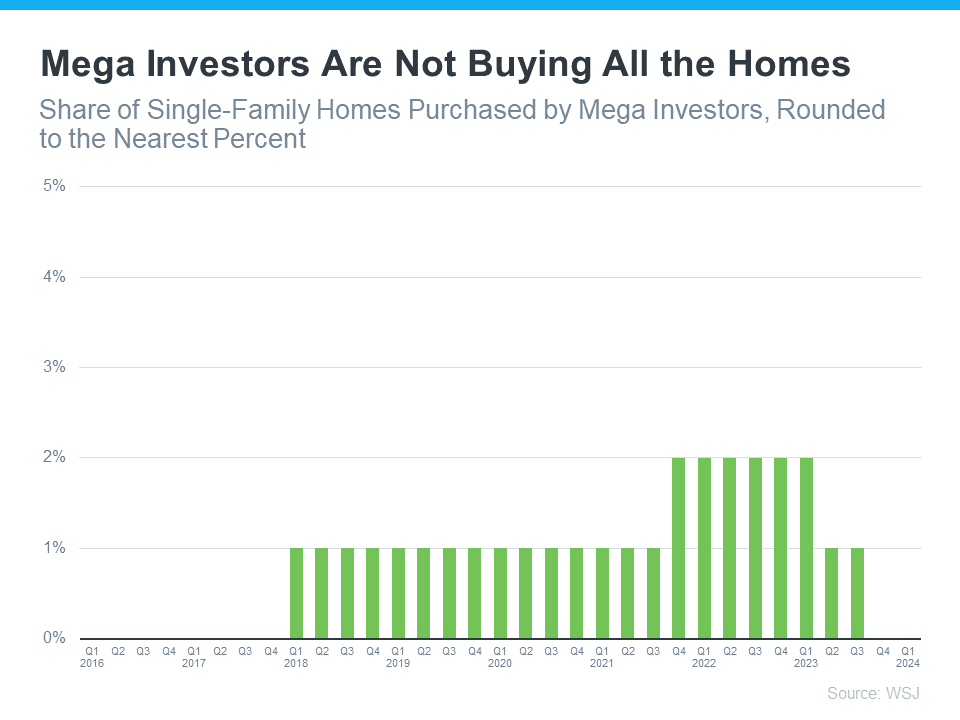
But let’s focus on the giant, mega-investor firms since that's what is being talked about so frequently on social media right now. Mega investors are those who own 1,000+ properties. You may be surprised to see that, according to the Wall Street Journal, they don’t buy all that many homes (see graph below):

No Caption Received


This graph tells us two things. First, institutional investors were never buying a large percentage of available homes. During the peak in 2022, they bought about 2% of available single-family homes. Second, that percentage has gotten even smaller recently (so small the number rounds down to 0%).

In an effort to understand why that percentage is trending down, private lender RCN Capital asked investors about the challenges they’re facing. Here’s what Jeffrey Tesch, CEO of RCN Capital, found out:

“Investors are already facing many challenges in today’s housing market – rising prices, limited inventory, and higher financing costs.”

Understanding these challenges is important because they show big, mega investors aren’t taking over the housing market.

So, don't fall for everything you hear. They aren't snatching up all the homes and making it impossible for regular people to buy

Bottom Line

Big investors aren’t buying all the homes out there. If you've got questions about what you're hearing about the housing market, let's chat. I can help you understand what's really going on.

Posted in Market Updates
May 21, 2024

Worried about Home Maintenance Costs? Consider This

Worried about Home Maintenance Costs? Consider This

BLOGMay 21, 2024

If one of the main reasons you’re hesitant to buy a home is because you’re worried about the upkeep, here’s some information you may find interesting on both new home construction and existing homes (a home that’s been lived in by a previous owner).

Newly Built Homes Need Less Upfront Maintenance

If you can afford it, you may find a newly built home could help ease your worries about maintenance costs. Think about it, if everything in the house is brand new, it won’t have the wear and tear you may see in an existing home – and that means it’s less likely to need repairs. As LendingTree says:

“Since the systems, appliances, roof and foundation are new, you’re less likely to pay for major or minor repairs within the first few years of homeownership. That can make a big difference for first-time homebuyers who are adjusting to owning rather than renting.”

Plus, many builders also have warranties on their homes that would cover some of the more major expenses that could pop up. As First American explains:

The new systems in your home, like plumbing, electrical, and HVAC, are typically covered for one to two years by your builder’s warranty. When something happens to these systems, you contact the builder or their warranty company.”

Existing Homes Can Still Have Great Perks

But it’s worth mentioning, that it’s not just newly built homes that can have warranties. It’s an option for existing homes too.

Your agent may be able to help you negotiate with the seller to add one as a concession on your contract. But you should know that not all sellers will be willing to do that. If they won’t, you could purchase one yourself, if you’d like to. An article from Forbes explains:

During a real estate transaction, a home warranty policy can be purchased by the buyer or the seller.”

And there are benefits for both parties when it comes to a home warranty. According to MarketWatch:

“A buyer’s home warranty benefits both buyers and sellers, as it helps the seller close the deal while providing the future homeowner with peace of mind that they’ll be covered if a system or appliance breaks down . . . Sometimes, a seller will pay for the first year of the home buyer’s warranty to sweeten the deal, but it depends on the real estate market.”

If you’re interested in a home warranty for peace of mind, lean on your agent. They’ll negotiate on your behalf to see if a seller would be willing to cover one for you. Just remember, the likelihood of a seller throwing one in depends on conditions in your local market.

So, Should I Buy New or Existing?

While the need for less upfront maintenance is a great perk for new construction, there are some things a newly built home can’t provide that an existing home can.

For example, existing homes have a lot of character and charm that’s difficult to reproduce. The quirks that come with an older home may make it feel more homey. And, existing homes usually have more developed landscaping and a well-established sense of community. So, it can feel more inviting than something that’s a blank slate, like new construction often is. Not to mention, if you go with new construction, you may have to wait for the home to finish being built based on where it is in the process. It all depends on what’s most important to you.

Bottom Line

Whether you choose a newly built or an existing home, you may be able to ease some of your concerns over maintenance with a home warranty. To weigh your options and go over what’s the top priority for you, talk to the professionals.

Posted in Market Updates